Digital Commonwealth — Boston Public Library
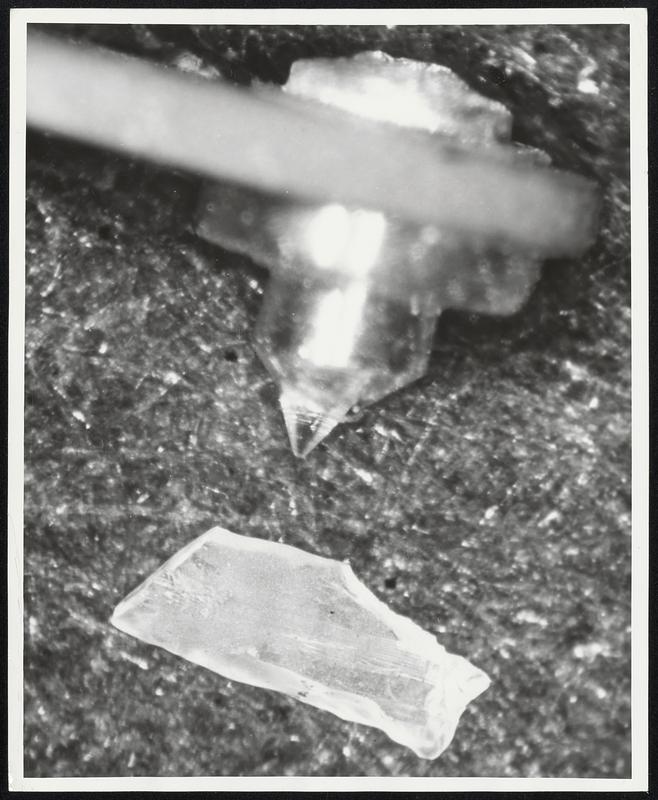
Diamonds made in the GE Research Laboratory crown 125 years of effort by scientists in many countries to duplicate nature's hardest and most glamorous crystals. Shown above is the largest diamond yet made in the General Electric Research Laboratory, by Dr. Herbert M. Strong, physicist. About 1/16th of an inch in longest dimension, it has been photographed beside a standard, diamond, high-fidelity phonograph needle to indicate its relative size. Success in making diamonds at GE came after more than four years of effort. Tested for hardness, the GE diamonds proved to be the first man-made substance able to scratch other diamonds. Pressures greater than 100,000 atmospheres or 1,500,000 pounds per square inch were achieved an temperatures above 5000 degrees Fahrenheit were maintained for relatively long periods. Some processes produced diamonds in a matter of minutes. Single runs of the press have often yielded solid clusters containing as much as 1/10th of a carat. Many variations of color, clarity, and crystallinity found in natural diamonds have been observed in the man-made crystals. Professor N.V. Sidgwick of Oxford University, world authority on Chemical Elements and Their Compounds (1950), says, "The artificial production of diamonds has never been a success," and concludes further that it is very improbable any efforts made thus far to produce diamonds have succeeded. Certainly no sure method of repeatedly making diamonds has ever been announced before.
[ca. February 1955]
[Information from item housing] Diamonds-- Diamonds
🔒
Order museum-quality prints
Sign in to order prints, canvas, and more of this work. Browsing and full-resolution downloads stay free.