The Changing Congress; Wishes of the Voters
National Educational Television and Radio Center · June 20, 1965
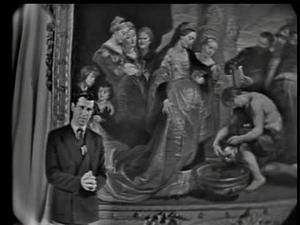
The conflicts a Congressman experience between dealing with legislative matters in Congress and in devoting time and energy to his constituency in his district are examined in Our Man in Washington. Our Man in Washington pinpoints these pressures as they are handled by Representative F. Bradford Morse (R Massachusetts), a third-term Congressman and House Foreign Affairs Committee member. Representing the Fifth Congressional District, the liberal Republicans constituency includes sixteen towns and four cities. Among them are the economically hard-pressed city of Lowell, which comprises many ethnic groups and is primarily Democratic, and the wealthy towns of Concord and Lexington, both with Republican majorities. Representative Morses trips every other weekend to his district illustrate his efforts to balance his dual obligations to his district and to the nation. Our Man in Washington follows Congressman Morse as he makes his rounds meeting professors in Concords town hall to discuss the Vietnam crises, keeping pre-scheduled appointments with his constituency in his Lowell office, visiting workingmen in neighborhood taverns and stores, talking to businessmen, holding a free-wheeling session with his volunteer staff workers to find out the local gripes and needs. Discussing the perennial questions of whether a Congressman is the constituents voice or the voice of Washington, Representative Morse says its a little of both. (Description adapted from documents in the NET Microfiche) Covering the broad spectrum of our nation's legislative branch, "The Changing Congress" explores with interviews, commentary, film excerpts, and on-location coverage the colorful history of Congress, its evolution, development, problems, achievements, operation, inner workings, image, performances, relationship with other government branches, its function as the representative body of the American people, and future courses. The Changing Congress scrutinizes where the power lies in Congress, Washington life as seen through the activities of a Senator and Representative, the power structure and hurdles that must be surmounted for legislation to pass, the pros and cons of Congressional probes, influences of the constituency and lobby groups on Congress, the increasing dominance of the executive branch with respect to legislation, the extent to which Congress shapes foreign affairs, and proposals for Congressional reform. The series host, John F. McCaffrey, dean of Washington television news correspondents and award-winning commentator, has been an observer of the Capitol Hill scene for more than twenty years. Mr. McCaffrey started in news broadcasting while working as a newspaper reporter prior to World War II. Following active service, he joined the Washington bureau of CBS. Later, he served as Washington editor for Mutual Newsreel of the Air. In 1954, he started his own Washington bureau, serving mid-western radio and television stations. Besides appearing on television, Mr. McCaffrey hosts, "Today in Congress," the only daily radio program devoted to Capitol Hill happenings. A lecturer and author of political affairs, Mr. McCaffrey is a two-time winner of the Washington chapter of the Academy of Television Arts and Sciences Emmy Award. The Changing Congress is a 1965 production of National Educational Television. It consists of 9 half-hour episodes that were originally recorded on videotape. (Description adapted from documents in the NET Microfiche)
Sign in to order prints, canvas, and more of this work. Browsing and full-resolution downloads stay free.