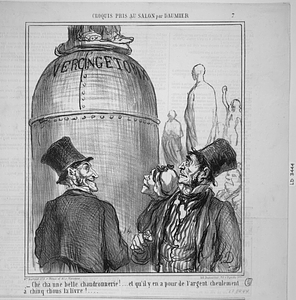
DEVANT LE TABLEAU DE M. Gustave MOREAU - Un chat décolleté avec une tête de femme, ça s'appelle donc un Sphinx? - Certainement.... en grec.
Trustman, Benjamin A., Trustman, Julia M. · 1864
A man is thinking about a Gustave Moreau painting of a cat with décolleté and thinks it must be a Sphyinx. MOREAU, Gustave (1826-1898) Painter of “Oedipus and the Sphinx” (today at the Metropolitan Museum of Art in New York). CROQUIS PRIS A L'EXPOSITION par DAUMIER and Croquis pris à l'exposition is a series of 4 prints, which appeared in the Charivari between May 24 and June 17, 1864, and on June 3, 1865. SALON. The SALON, the yearly art exhibitions in Paris, were actually art fairs which attracted approximately 1 million visitors from Paris and the provinces. Hundreds of painters and sculptors exhibited. The Salons were the ideal marketplace for the classical painters as well as the new, modern, avant-garde artists. Having little access to private art galleries, these exhibits were especially for the progressive school of greatest economic importance. The jury played an increasingly important role for the future of an artist. Once an artist was rejected from the Salon by a conservative jury, he had most likely no chance to succeed commercially. Very often, a parallel Salon was organized for those artists whose works were refused at the official exhibition . This was the case in 1855, when Courbet’s pictures were considered too revolutionary to be exhibited at the Salon. As a consequence, Courbet opened his own exhibition outside of the official Salon. Baudelaire made some remarks concerning the Salons: “During our time there are only two artists in Paris who are as able as Delacroix: the caricaturist Daumier and the second one is Ingres. All three of them have one thing in common: they express what they mean to say…..” The SALON was for most artists the only possibility to present their works to a greater public. The Salon of 1834 for example attracted some 30’000 visitors already on the opening day. During the entire period of two months, a total of one million spectators went to the show. On certain days the ticket price was reduced to 20 sous or was even free of charge, attracting a large number of visitors. During the World Fair, which lasted from May 15 to November 15, 1855 thousands of visitors from Paris and abroad as well as from the French provinces visited the Salons. SPHINX (Egyptian and Greek mythology): A monster whose upper part was a woman. The lower part of the body was a dog with the tail of a snake, wings, lions paws and a human voice. She ate all Thebans who could not answer her riddle, but when Oedipus knew the answer, she killed herself. The origin of the sphinx is Egyptian, where it was a male figure. It was taken over by the Greeks who represented the Sphinx as a female figure.
Sign in to order prints, canvas, and more of this work. Browsing and full-resolution downloads stay free.