EARLY MEDIEVAL MOUNT
450
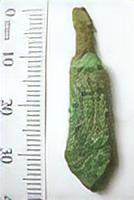
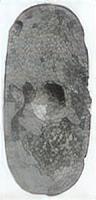
An Early Early-Medieval (Anglo Saxon, c.450-550) near complete copper alloy mount, possibly for furniture or a strap, with (now red) enamel decoration. The edge is cracked in one place and bent upwards a little. There are two holes in the plate, and the central rivet hole (2.85mm in diameter) has traces of iron corrosion inside it. The finder reports that there was a small amount of iron on the reverse that came off in his hand when he lifted it out of the ground.At the centre of the plate, around the rivet hole, is a hexagon. Inside is a sexfoil and the resultant triangles all contain a circle (c.2.5mm diameter) filled with red enamel,excet for one which has a hole piercing through to the other side. Outside the hexagon is a concentric ring (c.25mm diameter and 0.8mm in thickness), the area between being filled with red enamel. Between this and another concentric ring (diameter c.55mm) are three pairs of confronted animals, their heads turned backwards, biting their tails which curve upwards over the rump and along their backs. These pairs are equally spaced and on a backing of red enamel, with red enamel eyes. Each animal has two visible limbs, each with three toes.Outside the larger concentric circle is a ring of narrow, elongated isoceles triangles, arranged with the point towards the concentric ring. Between this area and the 2.8mm wide edge of the object is a c.4mm wide area filled with decoration comprising alternating three annulets with four (some apparently five) conjoined X shapes, all in copper alloy on a red enamel background. This pattern is repeated seven times.To the reverse the object is flat, with filled holes behind the five circles in the triangle decoration. These filled holes are also apparent behind the eyes and the circles beneath the chins also apparently inside the curve of the tails.The object has been professionally cleaned to remove the copper alloy corrosion apparent in the 'before' photographs. The red enamel survives in a remarkably good condition though is missing in some areas, notable between the animals confronted bodies at either end and around the hexagon. The bent part of the object is also missing enamel around the border and the pair of animals at this point have some pitting in the copper alloy.The object measures 78.40mm in diameter, is 2.11mm in thickness and weighs 55.61g.Barry Ager, British Museum, comments: "There are no examples of enamelled objects in the Quoit Brooch Style and I don't think that this is one, but it is certainly right to point to a connection. What appear to be related, back-turned, crouching animals, placed back-to-back and with their tails to their mouths, occur on the QBS belt-plate from Meonstoke (see my note in Anglo-Saxon Studies in Archaeology and History, 9, 1996, pp. 111-114), although they are decorated with dots, lines and scrolls. The plate can be dated to the middle quarters of the 5th century. Similar animals, but decorated this time with repoussé arcs and dots and not QBS, form mounts on a bronze-bound vessel of the later 5th or early 6th century from Bidford-on-Avon, which is most likely an 'import' from northern Gaul (V.I. Evison, 1965, The Fifth-Century Invasions South of the Thames, 22-3). On stylistic grounds, these two objects may support a date for the disc around the mid-5th to early 6th century. I am not sure what the connection is: the disc possibly indicates influence from the QBS 'school', or from early Frankish northern Gaul. But the sub-Roman/Celtic nature of the decoration, including the enamelling and the central 'marigold' motif, would be a matter for a Celtic specialist" (pers.comm. April 2013).Sue Brunning, British Museum, comments with contributions from colleagues: "Apart from the concentric zoning - which I suspect is primarily a product of design possibilities on a flat disc - the only thing that might be seen as a link to Romano-British enamelwork is the use of a vandyked border, which is a commonly used motif on a variety of Romano-British enamelled objects ( see for example some refs in 'The Ilam Pan', Chapter 5 in D. Breeze (ed) The First Souvenirs. Enamelled Vessels from Hadrian's Wall, Cumberland and Westmorland Antiquarian and Archaeological Society Extra Series No. 37, 2012, 41-60, esp. 53, 56), including the small handled pans (Moore's Group B: Braughing, Linlithgow etc), the 'miniature altars'/ 'stools' (Farley Heath, Wadenhoe etc) and one of the sub-types of Romano-British cosmetic sets (Jackson Type J). The heyday of those is 1st - 3rd century. I'm sure Barry is right to date the roundel 5th cent. The grey appearance is surely likely to be due to tin-enrichment (natural) of the surface. The mount has compositional parallels (in terms of how the designed in laid out) with a horse pendant from Fremington Hagg (British Museum 1880,0802.152)" (pers.comm. May 2013).
Sign in to order prints, canvas, and more of this work. Browsing and full-resolution downloads stay free.