MEDIEVAL AMPULLA
1350
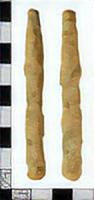
An incomplete cast lead Medieval pilgrim ampulla (c. 1350-c. 1500). The ampulla has a semi-circular bottom and the neck has straight edges. However, the neck has ragged breaks and is incomplete. The side lugs are intact but flattened. The obverse of the body, the more convex face, has the remains of a raised grid pattern. The reverse appears to be plain although it may have had a design prior to being corroded and worn. Around the peripheral edge of the body there is a casting seam. This ampulla is in poor condition and has traces of a matt buff patina. Some of this patina may have flaked off recently. The breaks and fractures are old. 50.0 x 29.4 x 5.9mm. Weight: 30.77g. Brian Spencer, formerly Senior Keeper at the Museum of London, who made a life-time study of ampullae, has written: 'Ampullae or miniature phials were an important kind of souvenir. Generally flask-shaped, but with a narrow, flattish section, they were designed to contain a dose of the thaumaturgic water that was dispensed to pilgrims at many shrines and holy wells. Ampullae were made of tin or lead or tin-lead alloy and were provided with a pair of handles or loops so that they could be suspended from a cord or chain around the wearer's neck. Coming into use in the last quarter of the twelfth century, they were, in England, almost the only kind of pilgrim souvenir to be had during the thirteenth century. They were nevertheless available at a number of shrines, and thanks to returning pilgrims or to local entrepreneurs, probably featured as secondary relics in virtually every thirteenth-century English parish church. Until the early fourteenth century, ampullae took various forms, were frequently inscribed and usually bore representations of the cult-figure or relic that they were intended to commemorate......Ampullae could be comfortably kept on the person or easily hung up in the home, or suspended , for the benefit of livestock, in the stable or cow shed or on the beehive. Ampullae were often donated to the neighbourhood, to be hung in the parish church. Almost as a matter of course, churches throughout thirteenth-century England secured possession of Canterbury ampullae containing what was perhaps the most famous of all elixirs, the water of St Thomas, tinged with the martyr's miracle-working blood' (Spencer, B. 1990, 57-58).
Sign in to order prints, canvas, and more of this work. Browsing and full-resolution downloads stay free.