MEDIEVAL AMPULLA
1300
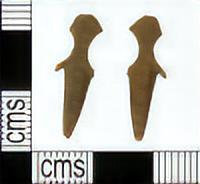
A lead pilgrim’s ampulla dating to the medieval period. The ampulla is of the familiar miniature phial shape with a small v-shaped handle at either side of the neck. The neck of the ampulla has been crimped together, and although the object is worn and slightly damaged through time, it appears to have been unopened.The body of the obverse is decorated with a lis set within a circle. The circle itself is also enclosed by a pelleted band. The lis is very thin and spacious, rather than the traditional close, neat fleur-de-lis seen on other ampullas. The perimeter of the body of the obverse is decorated with a band of 'x's. The reverse of the ampulla also has the same perimeter decoration. In the centre of the body there is a crown with a central lis and two half-lis at either end. The crown is double banded and sits above what may be a capital 'T' in Lombardic style, probably to signify St Thomas of Canterbury. To either side of the crown and 'T' is a branch with three smaller stems to it. The upper most two stems terminate with three pellets, representing flowers. The lower stem terminates with a pellet within a ring of six pellets, representing a flowerhead. An ampulla is a miniature flask or phial that carried holy water dispensed to pilgrims at shrines and holy wells, and are basically a pilgrim souvenir. They could be suspended and worn around the pilgrim’s neck, or hung up in houses and barns. The water within them may have been in contact with a relic associated with different Saints, and the designs on the ampullas often reflected the figure or relic they were associated with.
Sign in to order prints, canvas, and more of this work. Browsing and full-resolution downloads stay free.