Digital Commonwealth — Boston Public Library
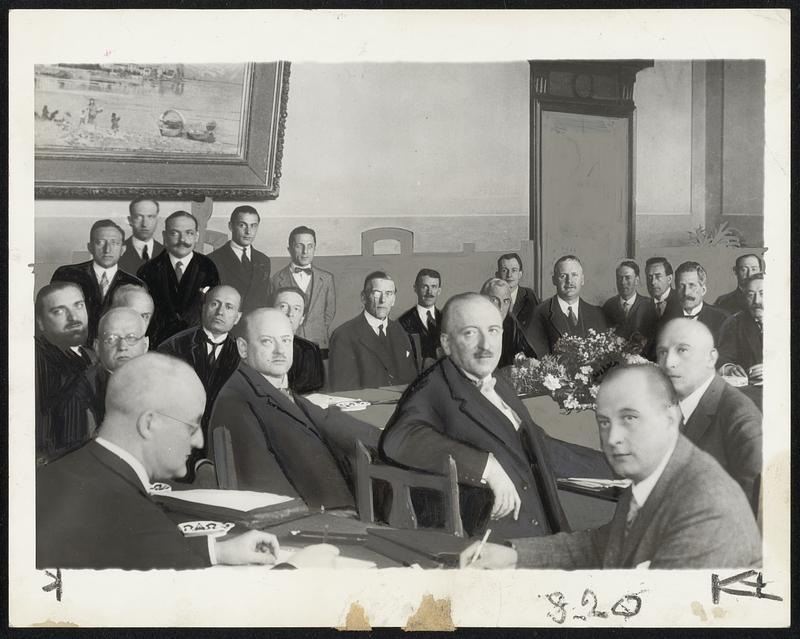
When the Locarno pact was signed, Oct. 16, 1925, existing frontiers were guaranteed, and immediately afterward Germany entered the League of Nations. This pact and the Versailles treaty were violated when Reichsfuhrer Hitler announced reoccupation of the Rhineland by Nazi troops. Signing of the Locarno pact is shown. Among those representing the powers at Locarno were (left to right) Dino Grandi, Italy (with beard), now ambassador to Great Britain; Hans Luther (wearing glasses), now German ambassador to the United States; Benito Mussolini (seated in background): Gustave Stresemann (facing camera in front and to right of Mussolini), then German foreign minister; Sir Austen Chamberlain (wearing monocle), England, and (seated at table at extreme right, with cigarette), Aristide Briand, France.
Associated Press · [ca. March 1936]
[Information from item housing] League of Nations
🔒
Order museum-quality prints
Sign in to order prints, canvas, and more of this work. Browsing and full-resolution downloads stay free.