Digital Commonwealth — Boston Public Library
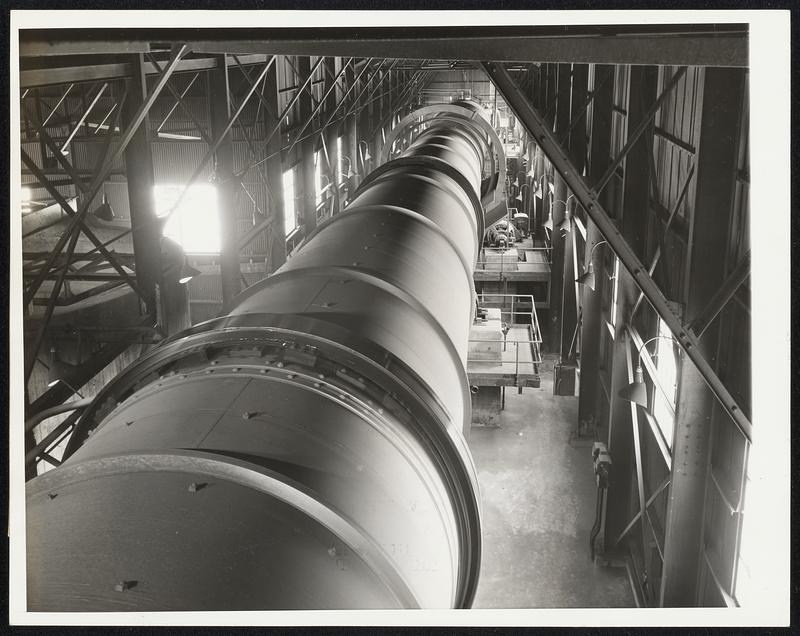
A Vital Wartime Metal - Trouble for the axis is cooking in 270-foot oven at the Anaconda Copper Mining Company's reduction plant here. Largest in the world and the only oven of its kind in the United States, it was put into operation nine months ago at the request of the government, to meet war needs. Its 2,000,000 cubic feet of natural gas used daily would bake many a biscuit. Put to war use, it turns out 300 tons daily of manganese oxide nodules, necessary in the production of armor plate and other shock resistant steels. Manganese oxide is not much to look at, in dull black nodules the size of a small marble, but it is very essential to the steel-maker. As the manganese comes from the Emma mine in Butte, Montana, only present source of manganese carbonate in the country, it appears in shades of pink, ranging from pale rose to deep coral shipped to the reduction plant at Anaconda, it is crushed and milled until almost as fine as flour, then, by "flotation," that mysterious process in which bubbles are used to separate valuable metal ores from useless rock, the lead and zinc are first removed. Another flotation, using soap bubbles, lifts out the manganese carbonate. Pumped to "slurry tanks," some of the moisture is removed by settling and the slurry, containing 30 percent water, goes to the rotary kiln, dried and roasted, it loses its carbon dioxide and forms nodules of the oxide. Dull black in color, now, it is ready for open hearth steel production. The uninterrupted flow of the metal assures plenty of trouble for Herr Hitler and his pals. Here is that great oven which is cooking up trouble for the Axis. Into one end of the huge rotary kiln/goes finely ground manganese carbonate. Roasted, the metal comes out at the far end in the form of nodules of manganese oxide ready for use in the production of open hearth steel.
Wide World Photos, Inc. · [ca. March 1942]
[Information from item housing] Manganese--Manganese
🔒
Order museum-quality prints
Sign in to order prints, canvas, and more of this work. Browsing and full-resolution downloads stay free.