Digital Commonwealth — Boston Public Library
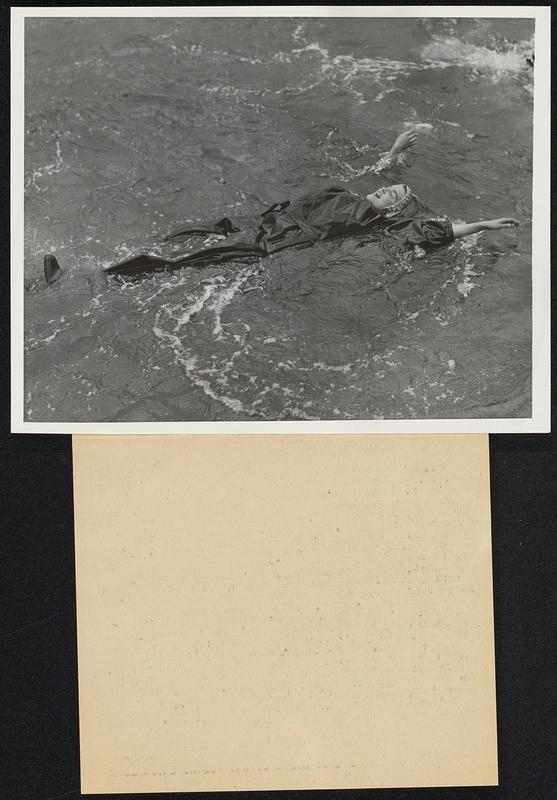
Testing New Life Saving Suit Mary Elizabeth Tommers afloat in New York harbor today in one of the new life savings devices, a rubber suit developed by the Norwegian Government, which when inflated keeps the entire body warm and dry and is expected to save thousands of lives of men thrown into the sea from mined and torpedoed ships in the Battle of the Atlantic. The demonstration was conducted by the Norwegian Shipping and Trade Mission. The suit is made in one piece similar to a sack, extending the length of the leg and ending in attached rubber boots. The suit continues from the neck upwards forming a hood and through the edge of the opening runs a draw-string which makes it possible to close the suit practically water-tight around the neck. The arms end in water-tight closures around the wrists. When the suit stands ready for use, it is folded down over the boots, put on in half a minute by stepping into the boots, drawing the suit with the hood over the head, putting the hands through the sleeves with the water-tight cuffs and drawing the cord around the neck. In order to make the suit water-tight the string is twisted once around the neck and the hood, shirred with elastic, fits tightly around the face and prevents the air, which is inside the suit, from escaping.
Wide World Photos, Inc. · [ca. June 1941]
[Information from item housing] Life Saving Equipment (Demonstration)
🔒
Order museum-quality prints
Sign in to order prints, canvas, and more of this work. Browsing and full-resolution downloads stay free.