Digital Commonwealth — Boston Public Library
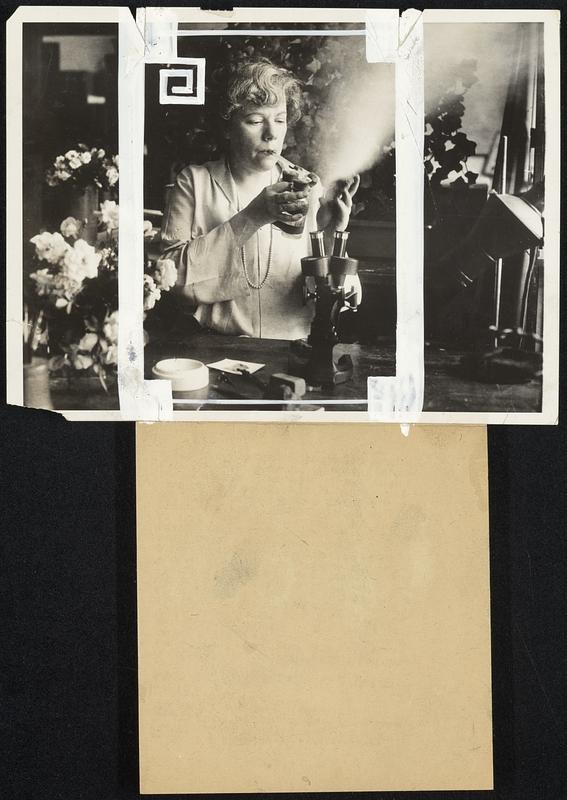
Study of Fossils Reveals Oil Deposits. Remains of tiny shellfish and other fossils believed to be from five million to twenty millions years old, are being used to assist in locating fields of buried minerals and oils. Experts studying areas of ground, looking for traces of oil, collect these tiny fossils, some of which are so small that they must be picked up with a camels hair brush, and send them to the laboratory, of the U.S. Geological Survey in Washington for classification. The fossils are reproduced in photographs enlarged from 25 to 150 times, so that their characteristics may be recognized easily. Fossils millions of years old often are marked very faintly. A blow pipe is used to spray white liquid over these shells to make the almost invisible markings stand out under the microscope. The spraying operation is shown above.
[ca. January 1925]
[Information from item housing] Fossil
🔒
Order museum-quality prints
Sign in to order prints, canvas, and more of this work. Browsing and full-resolution downloads stay free.