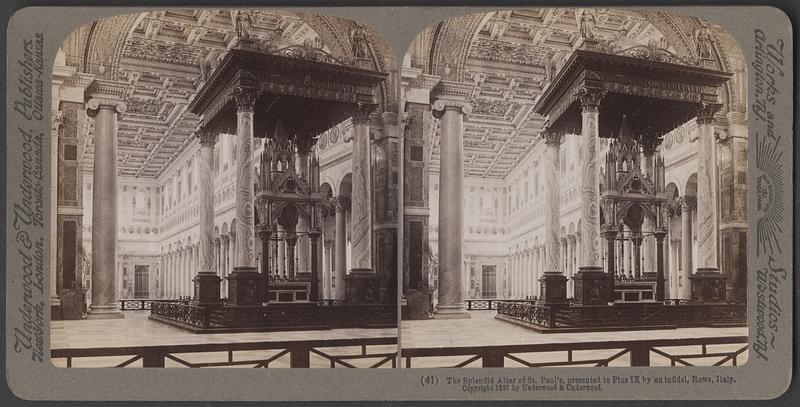
The splendid altar of St. Paul's outside the walls, Rome
Underwood & Underwood · (c) 1907
"This church in which we are standing is outside the city walls, on the edge of the mournful Campagna and close to the Tiber. The surrounding territory was not always desolate. During the middle ages large and flourishing suburbs stood here, but the fearful ravages of the Roman fever transformed the place in a desert. The more ancient structure which stood here was destroyed by fire in 1823, and this basilica took its place in 1854. It is 410 feet from the apse to the far end of the nave of the church, along which we are now looking, and the width is 222 feet. Four ranges of violet granite columns with white marble bases and capitals surround this space. Above the inner rows of columns we may see a series of mosaic portrait of the popes - each of these portraits is five feet in diameter. The grand arch resting on the two superb Ionic pillars, just beyond and above the altar - the left hand one we can see plainly - belongs to the old basilica, erected in 386. We catch enough of the fine sweep of the arch to note the beautiful carving which covers it. The high altar is supported by four pillars of oriental alabaster, presented by a Mohammedan, Mehmet Ali, Viceroy of Egypt. Beneath the high altar the Apostle Paul is said to be buried." Extracts from Rome through the Stereoscope, by D. J. Ellison, D.D., with special "keyed" maps locating each standpoint and identifying important landmarks; published by Underwood & Underwood.
Sign in to order prints, canvas, and more of this work. Browsing and full-resolution downloads stay free.