Digital Commonwealth — Boston Public Library
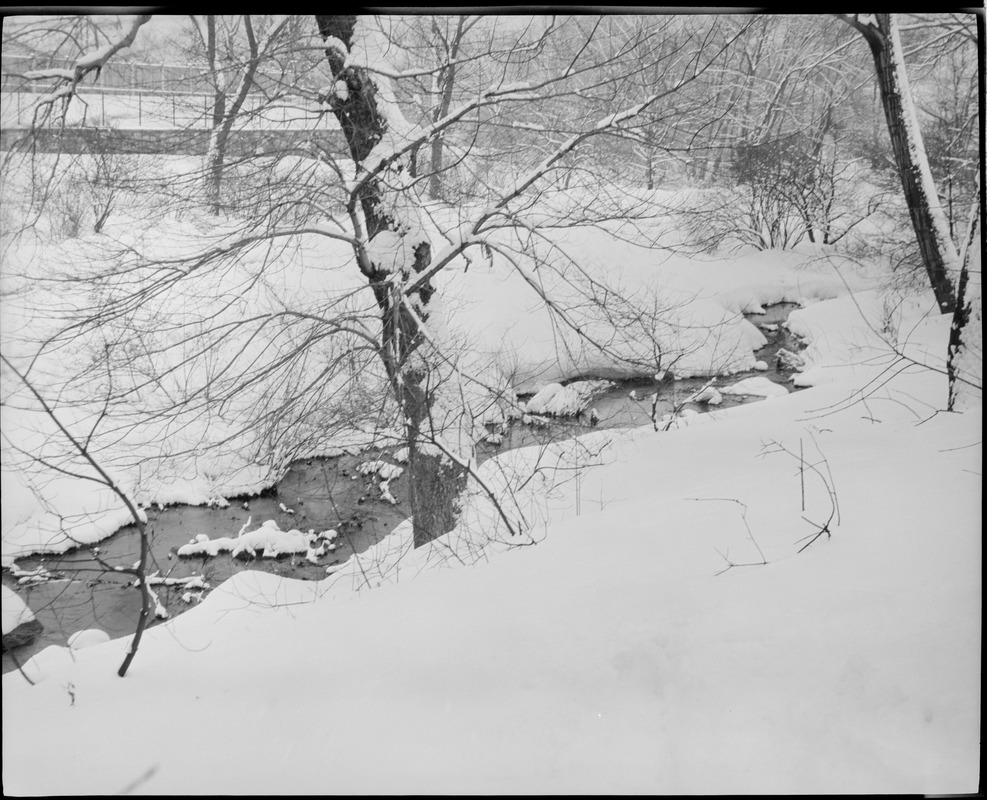
Olmsted parks in snow
Jones, Leslie, 1886-1967 · [ca. 1920]
CC0 — Public Domain
Digital Commonwealth — Boston Public Library
🔒
Order museum-quality prints
Sign in to order prints, canvas, and more of this work. Browsing and full-resolution downloads stay free.
More from Digital Commonwealth — Boston Public Library
Digital Commonwealth — Boston Public Library
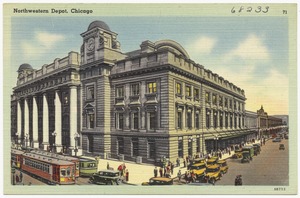
Northwestern Depot, Chicago
Unknown artist
Digital Commonwealth — Boston Public Library
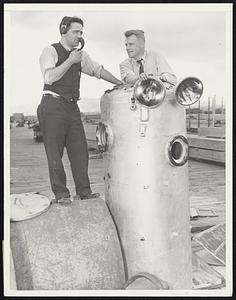
New Type Diving Bell to be Used in Search for Hidden Riches Below Sea's Surface. Los Angeles, Calif. -- Far beneath the surface of the sea, in the dark caves and submarine gardens, where men diving suits have not been able to venture, a Los Angeles inventor and deep-sea diver believes there lies a vast fortune in pearls and oyster shell. If 29-year-old William Lindley completes present plans, operation of a new type submarine diving bell in the deep pearl beds off the coast of Panama, expected to start within the next thirty days, may bring to light millions of dollars worth of heretofore unavailable pearls and shell. Lindley designed all the equipment and had charge of the diving and other operations in the raising in 1933 and 1934 of the steamship Islander, sunk in 365 feet of water in 1901 near Juneau, Alaska, with a huge cargo of gold. The new diving bell, weighing almost a ton, is cylindrical in shape, with dished ends. It is six feet four inches in height and has an inside diameter of 32-inches. There are two portholes of nine-inch diameter covered with one and one-half-inch shatterproof and bulletproof glass. The bell, with its five-eights-inch thickness of special steel in the sidewalls and seven-eights-inch thickness at the ends, will theoretically withstand a pressure equal to that encountered at 2500 feet sea depth, giving a five-to-one safety factor at 500 feet, which Lindley expats will be the maximum depth for its use in pearl-bed work. At present, a diver descends to sea bottom (at depth of about 120-feet) wearing a rubber diving suit, and with his hands picks up the oysters and loads into a basket, which when filled is hauled to the surface. These divers do not work more than a few minutes each day for fear of death from what submarine workers call "the bends." Lindley will descend in his tubular bell, and with two powerful submarine search lights will seek out colonies of oysters on the sea bottom. Even at a depth of 500 feet where the pressure is 250 pounds to the square inch, Lindley will work in comfort inside the bell under normal atmospheric pressure. As Lindley reaches sea bottom, he will give telephone orders to his mechanic assistant, who will remain on the surface to operate winches, etc. Once a colony of oysters is sighted by Lindley from the portholes of the bell, he will maneuver a large shell scoop into position and give the order for the scoop to be hoisted to the surface with the oysters it contains. A mechanical arm, controlled from within the bell, will maneuver the oyster scoop. With the oxygen tank and air purifier in the bell, Lindley can remain under water for as long as ten hours at a time. Should he encounter an accident under water, he need only release a 500-pound ballast and the bell will rise quickly to the surface. With his new type diving bell Lindley believes he can gather in excess of six tons of oyster shells in one day. -- Photo shows -- William Lindley, (right) shown with the diving bell he will use in hunting for pearls in the Pearl Islands area located west of Panama Canal. Jack Orlandi, his assistant, is seen speaking into communication phone.
Wide World Photos, Inc.

Digital Commonwealth — Boston Public Library
Pictures taken by Chu-Chu in Porto Rico
Sanromá, John B., 1900-1997
Digital Commonwealth — Boston Public Library
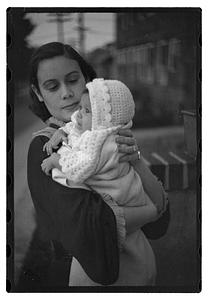
Mercedes Pasarell Sanromá holding a baby
Sanromá, John B., 1900-1997