Digital Commonwealth — Boston Public Library
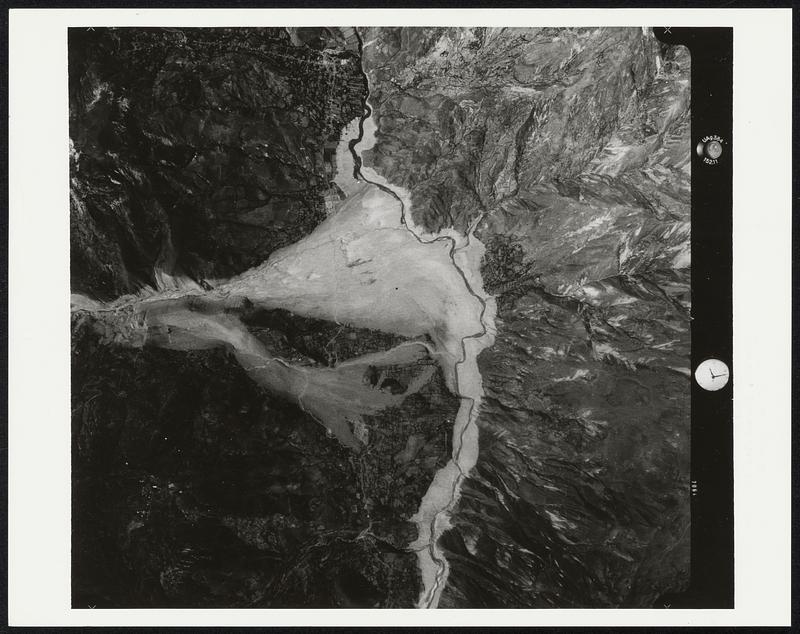
A National Aeronautics and Space Administration Lockhead Electra equipped to acquire black and white, color and color infrared photography and thermal infrared imagery, was used to obtain data over the area in northern Peru which suffered the most severe earthquake damage May 31, 1970. The government of Peru had accepted the United States National Aeronautics and Space Administration's offer to send one of its remote sensing aircraft to help assess damage resulting from the recent severe Peruvian earthquake. The data, in addition to helping the Peruvian government assess damage and plan reconstruction, will contribute also to the future application of the science of remote sensing to natural disasters. The color infrared delineates the edge of the slide more sharply than the color photographs. The avalanche of May 31, 1970, was caused by the earthquake. A huge slab of granite fell from the Nevado de Huascaran, picked up a volume of glacial silt equal to about three times the volume of the slab, and sailed down the canyon on a cushion of air. Most of the avalanche went down the path of the 1962 slide of the Santa River and then flowed down the river as a mudslide. One lobe, however, jumped over a 600-foot-high ridge and buried the town of Yungay. More than 20,000 people were buried by the avalanche.
United States. National Aeronautics and Space Administration · [ca. July 1970]
[Information from item housing] Earthquakes - Peru June 1970
🔒
Order museum-quality prints
Sign in to order prints, canvas, and more of this work. Browsing and full-resolution downloads stay free.