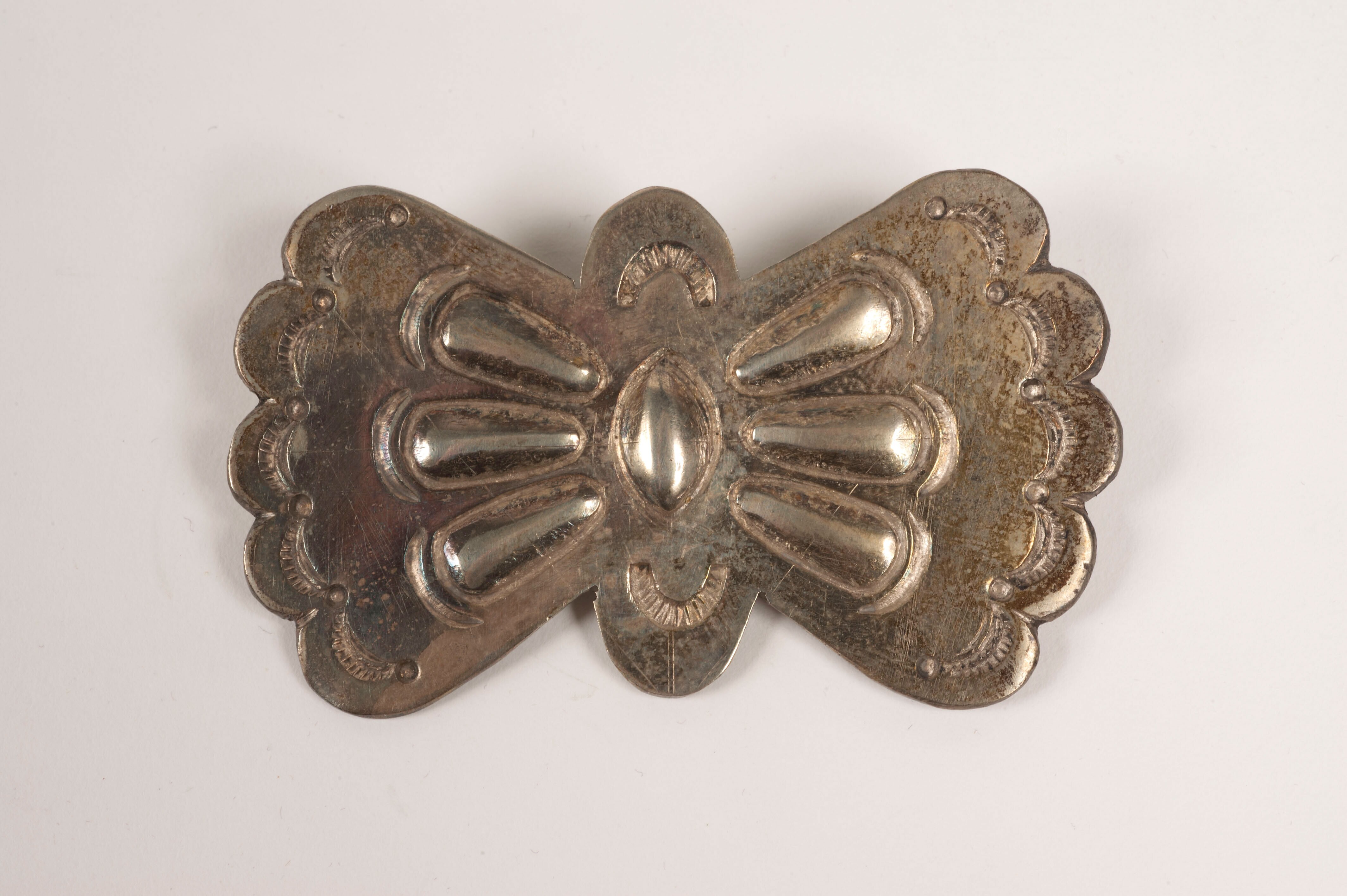
Silver brooch
1960
Navajo Silver. During the period of 1850-1860, the Navajos learned iron and copper forging from Spanish and Mexican blacksmiths. In 1863, the Navajos were militarily defeated by the U.S. Army led by Kit Carson and were deported to Bosque Redondo, New Mexico. There the blacksmith trade was further developed. In 1868 they were allowed to return to their motherland, where a number of them devoted themselves to the forging of silver. Many techniques were used, including cutting, engraving, hammering, embossing and casting. This led to a varied production, with the forging of silver jewellery in particular offering many opportunities for Indian artists to express themselves. The silverwork was further embellished with semi-precious stones among which the much used turquoise, a stone to which mystic power is attributed. Decorative and formal elements of Spanish-Mexican origin were often adopted, as were elements of Plains Indians, including the cross, the sun and floral motifs. Necklaces were traditionally worn and were now made of silver. This included jaclas or earrings which were sometimes attached to necklaces and led to more complex jewelry. Rectangular and oval silver plates and cut and hammered out (so called conchas) were given deco rations after which they were attached to leather hipbelts as decorations and/or buckles.After their return to the reservation, Navajos began to demand that they be paid in silver money for the land they had lost and the services they rendered to the gouvernment. This was done in Mexican pesos and U.S. dollars, which were then often made into jewelry, usually with tools of their own making. As the use of silver money dwindled, traders supplied slabs of one ounce silver. Jewelry became prized trade items both within the tribe and in barter with neighboring tribes. Many Navajos also invested their money in silver jewelry. This capital was easy to carry and an outward sign of wealth and prestige. The jewellery could also be exchanged at the trading posts on and around the reservations, where the silver objects were accepted as collateral or credit or as payment for western goods. Actual payment of pledge often took place in the form of wool or sheep, after which the Indians received their jewellery back. In this way, some families accumulated a valuable collection of antique silver jewelry over the decades.‖ For a time, the federal government provided the necessary tools for silver working because it allowed some Navajos to become self-sufficient again. The crafts were practiced as a cottage industry and in many hogans (Navajo huts) one could find an anvil and a table with tools of the ornamental smith. Often more than one family member was involved in this work. In general the knowledge was passed on from father to son and from uncle to nephew. Silver was not only worked, but silver jewellery was also cast in hand-carved shapes of volcanic tuff.‖ The trading posts came to dominate the silver and turquoise supply and the sale of tools. Jewelry was purchased or converted to credit and then sold to collectors and tourists who visited the Southwest in increasing numbers. At the request of trading post owners, jewelry was adapted to the tastes of white customers, including the production of less heavy jewelry. Initially, jewelry was sold by Indians at railroad stations to travelers or to hotel representatives who also operated souvenir shops within their walls. This market expanded rapidly at the beginning of the twentieth century and led, albeit on a modest scale, to the partly mechanized production of silverware. Indian jewelry was sold at visitor centers of nature reserves under the guarantee that it was handicraft, a federal government measure to protect traditional Indian craftsmanship.Shortly before World War II, the Indian Arts and Crafts Board promoted the manufacture, quality and sale of Indian silverware. A quality hallmark "U.S. Navajo" was introduced. The commercialization of production as a result of tourism led after the Second World War to the establishment of workshops where several artisans produced silver jewelry for the tourist market. Semi-finished products were also produced by machine on stamping and punching machines, followed by further processing by hand. Non-traditional decorative elements were incorporated. New products were also made in silver for which there was demand: tobacco and cigarette boxes, combs and letter openers. Because of the higher yield, a number of Navajo women made the switch from blanket weaving to silver forging. Over time, the market for Native American silver jewelry attracted non-Indian competitors. White silversmiths began to make jewelry in the Indian style, and Navajo jewelry was copied and exported in Japan. However, traditional and modern handicrafts continued to exist, largely due to the demand for quality products by wealthy customers and collectors, as well as the establishment of annual awards by institutions, often museums, for the finest jewelry. Indian artists experiment with new forms, materials and techniques and create objects, some of which end up in anthropological and art historical museums and private collections.‖ The basis for the manufacture of traditional silver jewelry by the Navajos is the concept of hozhro, often translated as beauty, which is central to their philosophy of life. It is not only an aesthetic dimension but mainly a substantive one in the sense that the concept has the meaning of harmony, fertility, life, health, cooperation and happiness, in short, everything that is good. The colours of the half stones used also have a symbolic meaning and are associated with the four cardinal directions. Navajos try to achieve a balance between the silver and turquoise used in the jewellery and partly because of this they make robust-looking jewellery. Dating Navajo jewelry is difficult because types have a high degree of continuity and stamps are often used for generations and inherited within families.\(PH, 1999)\The Butterfly button Euro-American traders often referred to a Navajo design consisting of a center element flanked by two radiating wings as a butterfly button.\The term butterfly is a western association and the form does not carry this connotation among the Navajo tribe. \The button was often worn on a dress and could be seen as a decoration on a belt. Sometimes it could also be seen on a ring or a bracelet. \Buttons were not commonly used as fasteners in the early period of silver work. \Small decorative buttons were made by pounding a dime or stamping a small silver disk.Buttons were usually attached to pants, blouses, pouches, bridles and other items by means of a loops soldered onto the back.Rows of buttons might even outline pouch straps. \Or might be used to decorate collar cuffs and seams of blouses. \By the end of the nineteenth century, small buttons were often fluted with a file or stamped.\nSometimes pins were indeed shaped like butterflies. \This particular example dates from 1910 and was probably stamped rather than hammered out.
Sign in to order prints, canvas, and more of this work. Browsing and full-resolution downloads stay free.


