Tile
Unknown artist
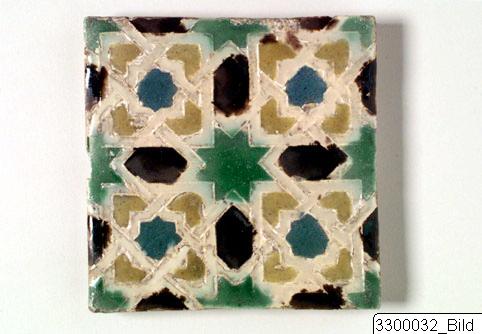
This moulded square tile of a hard yellowish paste shows a geometrical polychrome decoration of pinkish white interlacing bands forming green or pale blue glazed stars and dark brown or tan polygons in cuenca o arista technique. The central motif of the tile is a green eight-pointed star set in the middle of a cross composed of four opaque brown polygons. The latter divides the surface of the tile into four square compartments representing stellar and polygonal shapes. As the four green half-stars and brown half-polygons on the edges show, this tile was part of a repetitive design used in wall decorations. The cuenca o arista technique imitates tile mosaic. While the pattern of tile mosaic is made by cutting and assembling polychrome glazed tiles, the design of tiles worked in cuenca o arista technique is made by filling small pattern fields formed by thin strips of clay with different glazes. Where the glaze flowed over the frame, the design does not stand out clearly. The star and cross motif is one of the most common Islamic geometric decorative patterns continued in Mudéjar art. Source: [https://islamicart.museumwnf.org/database_item.php?id=object;ISL;se;Mus01;15;en&cp] How date and origin were established: Tiles similar in technique and design have been documented in buildings in Toledo dating from the end of the 9th / 15th century and the beginning of the 10th / 16th century, for example, in the monastery of San Clemente. How Object was obtained: The tile was purchased by the Museum of Cultural History in Lund, Sweden, from the Forrer collection in Frankfurt am Main, Germany, in 1922. How provenance was established: Tiles similar in technique and design have been documented in buildings in Toledo, for example, in the monastery of San Clemente. Source: [https://islamicart.museumwnf.org/database_item.php?id=object;ISL;se;Mus01;15;en&cp]
Sign in to order prints, canvas, and more of this work. Browsing and full-resolution downloads stay free.