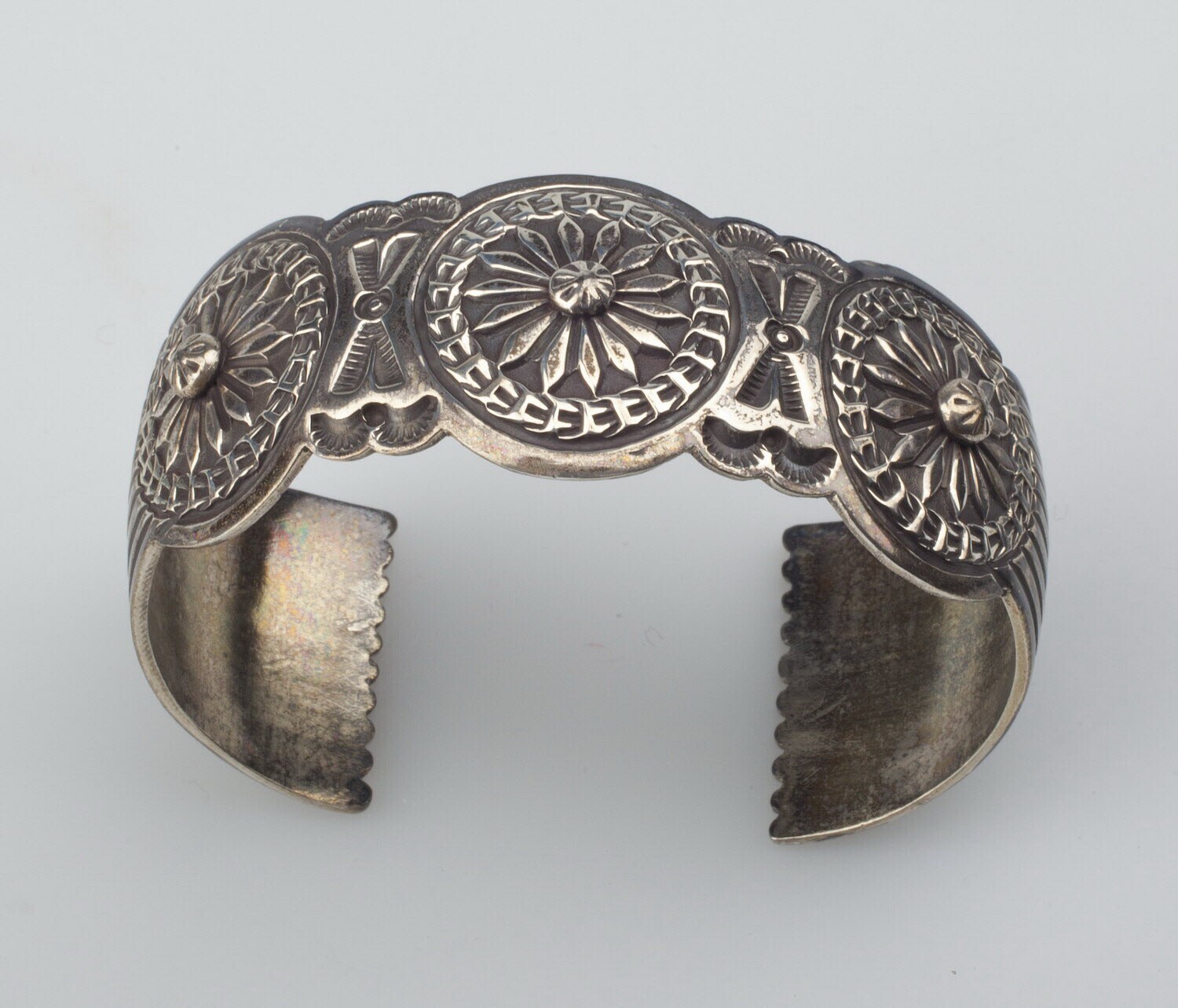
Bracelet
Unknown artist
Navajo Silver. During the period of 1850-1860, the Navajos learned iron and copper forging from Spanish and Mexican blacksmiths. In 1863, the Navajos were militarily defeated by the U.S. Army led by Kit Carson and were deported to Bosque Redondo, New Mexico. There the blacksmith trade was further developed. In 1868 they were allowed to return to their motherland, where a number of them devoted themselves to the forging of silver. Many techniques were used, including cutting, engraving, hammering, embossing and casting. This led to a varied production, with the forging of silver jewellery in particular offering many opportunities for Indian artists to express themselves. The silverwork was further embellished with semi-precious stones among which the much used turquoise, a stone to which mystic power is attributed. Decorative and formal elements of Spanish-Mexican origin were often adopted, as were elements of Plains Indians, including the cross, the sun and floral motifs. Necklaces were traditionally worn and were now made of silver. This included jaclas or earrings which were sometimes attached to necklaces and led to more complex jewelry. Rectangular and oval silver plates and cut and hammered out (so called conchas) were given deco rations after which they were attached to leather hipbelts as decorations and/or buckles.After their return to the reservation, Navajos began to demand that they be paid in silver money for the land they had lost and the services they rendered to the gouvernment. This was done in Mexican pesos and U.S. dollars, which were then often made into jewelry, usually with tools of their own making. As the use of silver money dwindled, traders supplied slabs of one ounce silver. Jewelry became prized trade items both within the tribe and in barter with neighboring tribes. Many Navajos also invested their money in silver jewelry. This capital was easy to carry and an outward sign of wealth and prestige. The jewellery could also be exchanged at the trading posts on and around the reservations, where the silver objects were accepted as collateral or credit or as payment for western goods. Actual payment of pledge often took place in the form of wool or sheep, after which the Indians received their jewellery back. In this way, some families accumulated a valuable collection of antique silver jewelry over the decades.‖ For a time, the federal government provided the necessary tools for silver working because it allowed some Navajos to become self-sufficient again. The crafts were practiced as a cottage industry and in many hogans (Navajo huts) one could find an anvil and a table with tools of the ornamental smith. Often more than one family member was involved in this work. In general the knowledge was passed on from father to son and from uncle to nephew. Silver was not only worked, but silver jewellery was also cast in hand-carved shapes of volcanic tuff.‖ The trading posts came to dominate the silver and turquoise supply and the sale of tools. Jewelry was purchased or converted to credit and then sold to collectors and tourists who visited the Southwest in increasing numbers. At the request of trading post owners, jewelry was adapted to the tastes of white customers, including the production of less heavy jewelry. Initially, jewelry was sold by Indians at railroad stations to travelers or to hotel representatives who also operated souvenir shops within their walls. This market expanded rapidly at the beginning of the twentieth century and led, albeit on a modest scale, to the partly mechanized production of silverware. Indian jewelry was sold at visitor centers of nature reserves under the guarantee that it was handicraft, a federal government measure to protect traditional Indian craftsmanship.Shortly before World War II, the Indian Arts and Crafts Board promoted the manufacture, quality and sale of Indian silverware. A quality hallmark "U.S. Navajo" was introduced. The commercialization of production as a result of tourism led after the Second World War to the establishment of workshops where several artisans produced silver jewelry for the tourist market. Semi-finished products were also produced by machine on stamping and punching machines, followed by further processing by hand. Non-traditional decorative elements were incorporated. New products were also made in silver for which there was demand: tobacco and cigarette boxes, combs and letter openers. Because of the higher yield, a number of Navajo women made the switch from blanket weaving to silver forging. Over time, the market for Native American silver jewelry attracted non-Indian competitors. White silversmiths began to make jewelry in the Indian style, and Navajo jewelry was copied and exported in Japan. However, traditional and modern handicrafts continued to exist, largely due to the demand for quality products by wealthy customers and collectors, as well as the establishment of annual awards by institutions, often museums, for the finest jewelry. Indian artists experiment with new forms, materials and techniques and create objects, some of which end up in anthropological and art historical museums and private collections.‖ The basis for the manufacture of traditional silver jewelry by the Navajos is the concept of hozhro, often translated as beauty, which is central to their philosophy of life. It is not only an aesthetic dimension but mainly a substantive one in the sense that the concept has the meaning of harmony, fertility, life, health, cooperation and happiness, in short, everything that is good. The colours of the half stones used also have a symbolic meaning and are associated with the four cardinal directions. Navajos try to achieve a balance between the silver and turquoise used in the jewellery and partly because of this they make robust-looking jewellery. Dating Navajo jewelry is difficult because types have a high degree of continuity and stamps are often used for generations and inherited within families.\ (PH, 1999)\This particular bracelet has a repetetive rosette design. \It is probably stamped and dates from about 1910-1930.\And the bracelet is perhaps the best known of all Navajo silver jewelry made. \It is the piece most frequently bought by tourists as a souvenir and perhaps the most worn artifact worn by the Navajo. \nAround 1846 it is was popular to wear brass rings around the arms; the larger the better.\Men as well as woman wore bracelets.\Poor indeed was the Navajo who did not have two or three bracelets.\Frequently a well-to do Navajo would have a dozen or more bracelets, while he would only own one or two strand of beads or single set of moccasin buttons.\It is almost certain that the brass bracelets were made by the Navajo themselves as they required only a length of brass or copper wire and files to produce decorative grooved.\Sometimes two or three bands of wire were twisted together.\In the early days of silversmithing, bracelets were mainly bread and flat. \nThey were made of melted silver and wrought (hammered into) a single piece.\nAs the silver smith attained more knowledge of soldering and stamping many more complicated forms were introduced.\nUp to that time all the decorative patterns were achieved by using files and cold chisels, or with impressions with steel stamps ( also called dies).\nThese patterns were largely rectangulinear (straight lines) because of the nature of the tools. \Now with the stamps more linear patterns were applied to the metal straight and curved lined could be easily by applied.The designs of the stamps ere derived from Mexican workers' tools.The setting of stones began about 1880 with the use of crude hammered bezels.Bracelets more than other forms of jewelry permit the use of large or multiple stones .\From the turn of the century turquoise and other stone have been primary importance in bracelet design.For the most part early bracelet design were small and flat and set flush to the bezel.In the 1910-1920s cabochon became prevalent.The use of added decorative elements on bracelets and other articles is a good indicator of the date of the piece. \Fine double twisted wire jewelry bracelets were common from the teens on.\The twenties an thirties saw elaborate designs of fine twisted and spiral write and in the 1930s bead wire imitation rows were frequently added. \nPatterns composed of small segments of bent wire and applique ornaments appeared at about the same time.\nThe stylistic development of Navajo Jewelry can be categorize into the following periods:\First period : the classic period(1860-1910)\Just when the Navajo started to work with silver is still a very debated subject. \No written record tells us exactly when Navajo metal smithing began. \nIt is generally assumed, however, that before 185o the Navajo obtained their metal jewelry through trade with the Plains Pueblo and Mexican peoplesThe incarceration at Bosque Redondo(1864-1868) also influenced the development of Navajo metal smiting. \One of the earliest smith are: ATSIDI SANI( old smith) and ATSIDI CHON( Ugly smith) astsi Sni is generally recognized as the first Navajo to have mastered metal smiting techniques.\As a student of Nakai Tsosi( Slender Mexican) worked solely with iron forging bridles and bits for trade. \nAtsidi SANI persisted in developing his skill during the years of confinement at Bosque Redondo, and Navajo men were indeed given tools for blacksmithing tools. \nAtside Sani was among several Navajo blacksmiths who ran to forges on the reservation and helped teach the craft to others. \nA small amount of brass copper and silver jewelry appears to have been made during this period after their release from Bosque Redondo many Navajo continued to work as blacksmiths and some eventually began silverworking. \All mid 19th century Navajo silver was hand hammered. \nAmerican coins, Mexican pesos or ingots were mainly used until the 1920's when various thicknesses of sheet silver and wire were introduced.\nAnother pioneer in Navajo silverworking was Atsidi Chon or \"Ugly smith".\nHe was probably the fist Navajo to create a horse bridle of silver(around 1870) and he also may have fashioned the first concha belt. \nAbout 1872 Atsisi chon taught the craft to the Zuni smith Lanyade.\nIn 1880 Atsid Chon or an apprentice named Peshlakai Atsidi(or Slender- Maker- or- sliver) was the first to set a turquoise stone in a silver bezel.\nThroughout the classic period, the form of silver pieces and also their decoration came to have iconography significance.\The colors of certain stones, such as turquoise an coral and the use of four decorative elements in a design became associated with the cardinal directions.\nDouble or paired forms suggested the relationship of earth and sky; six elements, for example a row of six tones echoed the six inner forms of the sacred mountains.\nOutside influenceThe Navajo obtained materials for metalwork through trade.\nLong-established trade systems with neighboring tribes and Mexican smiths provide them not only with necessary metals- iron, brass, copper and silver- but also with an array of metal forms and designs. \American and Mexican silver coins for instance were used to create the earliest silver jewelry.The Navajo concha, pomegranate( squash blossom button) cross canteen and motifs for bridle decorations were not unique inventions of the Navajo.They were borrowed and reproduced by the Navajo from the Plains and Mexican tribes. Often valuable goods and services were exchanged for silver. \For instance, for their iron and silver ornaments, livestock and fruit the Navajo received turquoise and shells from the Pueblos. \From their crude tools the early silversmiths developed and perfected their limited metal working techniques and often would invent new ones. \nThey acquired tools through trade or ingeniously construct them, fashioning bellows form goatskin and wood, molding forges form stick and mud and chapping crucibles from clay and sherd. \They also forged blowpipes from brass wires, chisels and stamps from railroad spikes and nails, and anvils from scarp iron and wood.\By 1870 the Navajo had mastered techniques such as annealing and soldering and had learned how to embellish their designs with stones.\Most importantly they invented the tufa-casting technique, in which silver coins and slugs were poured from crucibles into intricately carved sandstone moulds.\This technique allowed them to produce a wide range of shapes and designs that otherwise would not have been possible.\nEarly silverwork is distinguished by utter simplicity of both composition and technique due partly to the Smiths preference and the limit of tools and materials. \Most of the Conchas and buttons for instance are round. Bracelets tend to be wide and heavy.\nEarly artisans applied surface design by chasing, filing, and engraving and they attempted to add diversity and three dimensionality by stamping with simple crescent, round and sunburst pattern dies. \As new tools and techniques became more accessible and familiar to them the redefined borrowed motifs to reflect their own culture. \The colors of certain stones such as turquoise and coral and the use of four decorative elements in a design became associated with the cardinal directions.Doubled or paired forms suggested the relationship of earth and sky; six elements for example a rows of six stones echoed the six inner form of the sacred mountains. \By the early 1900s the availability of new tools and the mastery of new techniques allowed silversmiths a great range of artistic expression in design and form.Applying other techniques of repoussé chasing filing stamping and embossing and stone stetting to create elegant and aesthetic pieces.\nSecond period:, the period of commercialization (1910-1940)\nThe second period in the development of Navajo metal smithing was characterized by economic intervention, exploration and commercialization that almost in some retrospect almost extinguished the native tradition.\nThe white trader's appearance on the reservation during the 1870s had provided a new means of exchange and communication. \As the traditional system of trade gradually shifted in the direction of external economy. \The Navajo's bargaining position became dependent on the trader's cash flow and line of credit and on supply and demand of the outside market. \When the demand for wool, sheep, jewelry and textile declined elsewhere, so did the prices traders offered for the Navajo goods and livestock. \nThe result was a diminished cash flow for their trader and a decreasing line of credit for the Navajo consumer.\nMoreover the rising commercial tourist trade demanded inexpensive Indian-made curios and by 1915 cities such as Albuquerque, Gallup, Flagstaff and other cities along the Santa Fe Railroad had become bustling centers of commerce and trade in the Indian arts. \Local hotels and company such as the Fred Harvey Company, Maisel and Sun-Bell catered to the growing tourist markets furnished native artisans with an array of new tools, material and techniques.\nAlthough in the past increased access to tools and materials had inspired silversmith to cultivate Navajo design and techniques, during this period commercialization an economic exploitation discouraged authentic Navajo expression. \Cast work for instance disappeared almost entirely; hammering takes less time. \nSmiths, who were usually paid by ounces of silver made up, naturally used the quickest methods. \A lot of workmanship counted for nothing, so they crafted their product to the needs of the trader. \Some vendors did offer bonuses for good work, but they were few.\The need for financial security forced, however, native artisans to accept work in commercial jewelry businesses that mass produced curios for tourist.\Native craftsmen for coerced into adapting non traditional motives( swastikas, bows and arrows, thunderbirds) and non traditional forms( boxes, letter openers ashtrays, combs and beetle pins. \These bench pieces are characterized by their redundant form, repetitive design and unrestrained decoration. \They are characterized by a redundant form, repetitive design and unrestrained decoration. \From 1900-1920, as more people journeyed across the continent by train, a cheap, lightweight ring or bracelet with a stone or two was a favorite souvenir.It indeed became a stereotype of the Southwestern Indian.As the tourist industry dwindled during the depression years, silver production diminished an the metal working tradition was nearly lost.\Silver smithing was not the only aspect of Navajo life adversely affected by economic conditions.\ A scarcity of jobs on the reservation , combined with the reduction of sheep herds forced by the government, imperiled the very nature of the traditional Navajo culture and economy. More than ever, bother personal and newly fashioned jewelry as used as collateral at the trading post so the Navajo could purchase the requisite blankets and food as more an more Navajo locked the means to redeem their pawned jewelry. \By the 1930s, the technology for making jewelry changed rapidly, in part due to the availability of electricity. Additional fine lapidary equipment and jewelry tools, many imported from Europe allowed the Zuni tribe to do even more precise inlay and mosaic work more quickly.\After WWII the refineries shipped silver to jewelry supply houses in Gallup, Albuquerque, Scottsdale, Flagstaff and other mercantile centers. \Sheet silver and wire in many different gauges purchases at rendered the practice of hammering out slugs and drawing by hand obsolete. \To these same supply stores, machine shaped and polished turquoise was shipped from mines all over Arizona, Nevada and Colorado.\Whereas the jewelry made prior to 1945 was most part sold to tourists at trading posts ands shops in the southwest, increasingly after 1945 jewelry ash trays tableware cigarette boxes were sold through sales men hire by wholesale traders and earlier in distant cities from the reservation. \Since the 1960s southwestern jewelry has become fashionable all over the United States and has even reached shops in Europe and Japan.\In the years following WWII, the Navajo enjoyed a wider of range of educational opportunities. \They requested and received classroom instruction in Navajo art, culture and history and Navajo arisen and participated in the variety of programs at the Wingage Guild,(1930-1940).For instance well-known silversmiths were employed to teach the craft to youngsters.\Even today,schools still encourages excellence in design and craftsman.\Contemporary Navajo smiths are more individualistic in their approach and may apply traditional designs with western techniques.\At the end of the nineteenth century silversmithing had spread throughout the southwestern tribes.\It became very fashionable to wear silver jewelry in abundance on ceremonial and special occasions, mixing it with beads of turquoise shell and coral. \In the early days of silversmithing it was difficult if not impossible to get the metal out of its ores. \Most silver came from the Navajos in the form of coins that they received in trade or by raiding neighboring tribes. Silver like coral had become more valuable to trade than sheep and horses, it was considered a hard commodity ( as opposed to a soft commodity such as livestock). At a time when the Navajo just learned the craft, from the Mexicans for instance, the price of making a silver ring was one sheep. \Later on silver was also used to barter or as an item to pawn at local trading posts.\The pawn system was a type of credit whereby a Navajo could leave his jewelry as security against his purchases. \In a cash-poor society this form of exchange allowed the Navajo to weather the lean months before the harvest or the sheering of sheep earned him enough money to clear his debt.\It was understood that an individual could redeem his jewelry for ceremonial occasions and it would be returned afterward to remain his bond until his debts were paid. \Later regulations (1936) were passed specifying the length of time a trader had to keep the jewelry before it was legal to release it for outside sale, at which point it became Dead pawn.The more lavish pawn pieces were particularly bought by many collectors and museum curators and tourists. \The term "Old pawn" generally refers to the jewelry made before 1900.
Sign in to order prints, canvas, and more of this work. Browsing and full-resolution downloads stay free.


![Cardboard with 108 fantasy and mosaic beads [19403 - 19510].](https://api.europeana.eu/thumbnail/v2/url.json?uri=http%3A%2F%2Fcollectie.wereldculturen.nl%2Fcc%2Fimageproxy.ashx%3Fserver%3Dlocalhost%26port%3D17581%26filename%3Dimages%2F%2FImages%2FTM%2FTM-3407-1a-186.jpg&type=IMAGE)
