Conversations 1967; General Dwight D. Eisenhower
National Educational Television and Radio Center · August 6, 1967
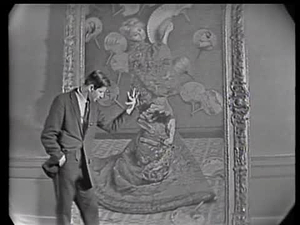
Filmed at New Yorks Gallery of Modern Art where an exhibition of the former presidents paintings and memorabilia is currently on display, this relaxed interview with reporter Patricia Marx touches on a variety of subjects ranging from the Generals remembrances of his early life and school days through the turbulent years of World War II, from his presidency to his reflections on world leaders he has known and his thoughts about his paintings. As the General and Miss Marx stroll leisurely through the Gallery, he relates the paintings and mementoes on exhibit to his life: On his decision to enter West Point: I was studying like anything for Annapolis when I found out I was too old, thats the reason I got in West Point. On arguing with Churchill over the Normandy invasion plans: He thought all of our troops should go in another direction. Well those were political reasons, I thought, and I said look, Im not a politician. You go back to my President and argue that. He said No, were talking military things, and I said, well, if its military I have to be the boss. So we had a seven-hour argument that afternoon and it was all very friendly, but it was very tough. On General de Gaulle: As a matter of fact I always kept him as a good friend but hes always been a very sensitive man and a very self-confident person, its not easy. On Nikita Khrushchev: He was two different men. He played the same old cracked record of all communists but in spite of that stubborn ideology he was expounding, when he came to see your grandchildren or visit with you in your home, why he was a very pleasant man and he just captivated my grandchildren thats all there was to it. On his first offer of the Presidency: In 1945 when the President (Truman) came to Berlin he said General, I just want you to know that I for one am ready to get you anything you want and that very definitely includes the presidency in 1948. I said, Mr. President, I cant think of anyone whos less interested and Ill never be, dont worry about that. But from then on, it began gradually to build up, this pressure, particularly after the President brought me back to be Chief of Staff and from then on I was never free of it, until finally I said, Here we go, lets go Monday. On the most significant accomplishments of his presidency: I think one material accomplishments was the interstate highway system of 41,000 miles and the other was the St. Lawrence Seaway. I think, in the political arena, there was the success we had in maintaining peace in spite of the many threats in Iran, Guatemala, Formosa, Lebanon, Suez and in Korea where the fighting was still going on when I went in. But from that time, in late June of 1953, when we stopped that, we never lost another soldier. That was something. On the possibility of World War III: As a matter of fact I still believe that the two main powers, with all of this atomic capacity, theyre still not anxious to use them on each other, no question about it. Im sure today, the Russian government, no matter how intransigent they are, how much they use lies and deceit and all the rest of it, they dont want major war any more than we do. On why he paints: Im fascinated with colors and I want to use colors as something I think will represent something to someone else. I am absolutely hopeless if you talk abstraction or heavy impressionism, I wouldnt know a thing about it because I want to paint something that you can see whether I use the color I should have or not As a matter of fact all of mine (paintings) would have been burned up, except people coming and seeing me painting said Oh, give me that Ike, or oh, please can I have this and so on, otherwise none of these would exist, I tell you. Conversations 1967-68 General Dwight D. Eisenhower is a 1967 production of National Educational Television. (Description adapted from documents in the NET Microfiche) Conversations 1967 brings together interviews conducted by KQEDs general manager, James Day, and Bostons Elliot Norton in one series of 6 half-hour episodes. The two hosts talk to a variety of performers about their craft, their careers, and their lives.
Sign in to order prints, canvas, and more of this work. Browsing and full-resolution downloads stay free.