Digital Commonwealth — Boston Public Library
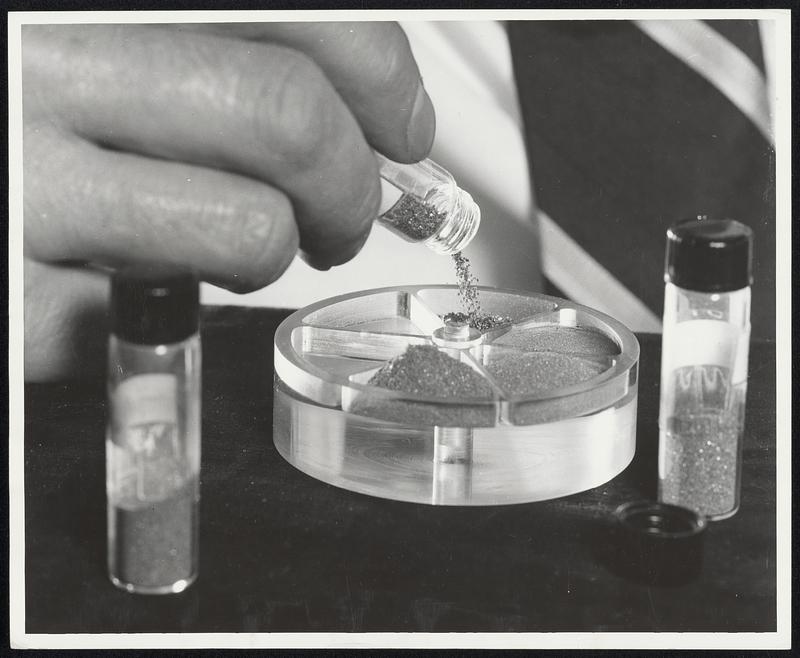
100 Carats of Man-Made Diamonds. General Electric scientist pours man-made industrial diamonds into a container for presentation to the Smithsonian Institution. A plaque commemorating GE's production of diamonds in 1954 was presented today (May 3, 1956) to the Smithsonian by Dr. C. G. Suits, GE vice president and director of research. The exhibit consists of a cluster of some of the first tiny diamonds made in the Research Laboratory, surrounded by 100 carats of man-made industrial diamonds, produced in a pilot plant at GE's Carboloy Department in Detroit. GE is now in limited production of the industrial-type stones. Importance of diamonds to U.S. industry was stressed by Suits in making the presentation of the historic stones to the Smithsonian. The availability of the man-made stones will have "an important impact on American industry and defense," he predicted, adding that recent progress in translating "a laboratory achievement into a commercial process" will give the U.S. an independent supply of a vital raw material for which it is now wholly dependent on imports.
[ca. May 1956]
[Information from item housing] Diamonds-- Diamonds
🔒
Order museum-quality prints
Sign in to order prints, canvas, and more of this work. Browsing and full-resolution downloads stay free.