Black Journal; Is Sweetback Really Sweet?
October 19, 1971
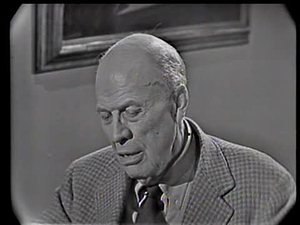
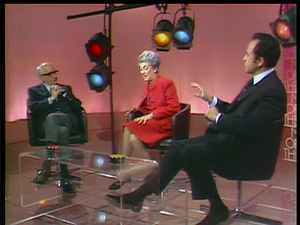
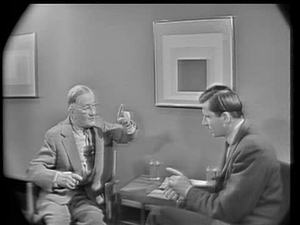
Filmmaker Melvin Van Peebles responds to the critics of his controversial film Sweet Sweetbacks Baadassss Song on Black Journal when the Emmy-winning series ask: Is Sweetback Really Sweet? The program focuses on the criticism and plaudits the film has received from the black community. It has been called both exploitative and a tool of liberation. The film is also discussed on Black Journal by Clayton Riley, a movie critic of the New York Times, who feels that Sweetback is the best black film he has ever seen; and Frances Ward of Chicagos Kuumba Drama Workshop and Peter Bailey, movie critic of Ebony Magazine, who attack the film as negative and exploitative. Written, produced and directed by Van Peebles, Sweet Sweetbacks Baadasssss Song centers around a professional sexual exhibitionist and proficient lover, who becomes transformed into a revolutionist. He kills several policemen and with the aid of the black community, some Mexican field workers, and his on ingenuity and sexual abilities escapes to Mexico. Black Panther Huey Newton has called it the first truly revolutionary black film. Van Peebles, who also stars as the her in the film, describes to Black Journal his feelings about his black critics: I got very positive feelings about it. It seems that our people have not had the courage, for all their loud talking towards this film, to attack the white man. And if they can get themselves together to attack meif this is what it takes to get the niggers mind workingthen perhaps it will become a positive thing. Bailey and Ward attack the film for its heavy emphasis on sex, which they believe fosters a negative image of the black woman and on of degeneracy in the black community. Both question the films merit as black art, stating that it is not functional to the black community because, in Baileys words, there is no vision, looking forward, or solutions offered. Clayton Riley offers his rebuttal to the criticisms leveled against the use of sex and violence in the film. For Riley pornography and prostitution are the white mans terminology and reflect a system of white values: We cant say that a culture is oppressive and then use its standard to describe something about yourself. Credits: Black Journal, a production of NET Division, Educational Broadcasting Corporation. Executive Producer: Tony Brown. The program is telecast nationally by PBS, the Public Broadcasting Service. Black Journal began as a monthly series produced for, about, and - to a large extent - by black Americans, which used the magazine format to report on relevant issues to black Americans. Starting with the October 5, 1971 broadcast, the show switched to a half-hour weekly format that focused on one issue per week, with a brief segment on black news called "Grapevine." Beginning in 1973, the series changed back into a hour long show and experimented with various formats, including a call-in portion. From its initial broadcast on June 12, 1968 through November 7, 1972, Black Journal was produced under the National Educational Television name. Starting on November 14, 1972, the series was produced solely by WNET/13. Only the episodes produced under the NET name are included in the NET Collection. For the first part of Black Journal, episodes are numbered sequential spanning broadcast seasons. After the 1971-72 season, which ended with episode #68, the series started using season specific episode numbers, beginning with #301. The 1972-73 season spans #301 - 332, and then the 1973-74 season starts with #401. This new numbering pattern continues through the end of the series.
Sign in to order prints, canvas, and more of this work. Browsing and full-resolution downloads stay free.