Black Journal; 30
Brown, Tony · June 28, 1971
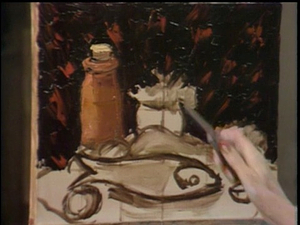
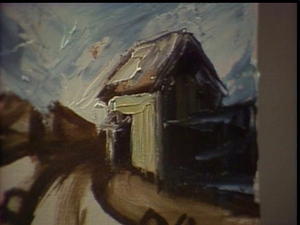
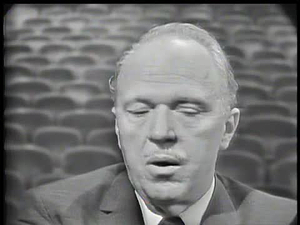
The role of the Black artist in conveying a message relevant to the lives of Black people is discussed by Jon Lockard, painter, philosopher and teacher. In his studio, a converted railway station in Ann Arbor, Michigan, Lockard paints on the theme of Black cultural pride. In one of his paintings, titled "Aunt Jemima," Lockard has portrayed this commercially exploited caricature as an angry woman, raising a clenched fist and donning a bandanna with the tri-colors of the Black liberation flag. The film shows Lockard in his studio with students who attend his classes in Black art at the University of Michigan and Washtenaw Community College, Ann Arbor. In a report from Detroit, Black Journal explores the problems and challenges confronting Black radio stations in relating to the Black community. Radio personalities from two Detroit stations, Black-owned WCHB and white-owned WJLB, make suggestions for improvement in Black radio broadcasting, which include better pay and improved working conditions for station employees. An official from a Black advertising agency charges that most white advertising agencies placing ads on Black stations refuse to hire Black copywriters. In another segment, entitled "Black Man, 1984," Black Journal will focus on eight-year-old Black children who will be potential members of the college class of 1984. The children interviewed in urban ghettos, in the country, in playgrounds, in classrooms, and at home, will offer their views on subjects such as Black power, Black marriage, Black leaders, Africa, war, Black politics, careers, and Black Panthers. Black Journal #30 is a production of NET Division, Educational Broadcasting Corporation. (Description adapted from documents in the NET Microfiche) Black Journal began as a monthly series produced for, about, and - to a large extent - by black Americans, which used the magazine format to report on relevant issues to black Americans. Starting with the October 5, 1971 broadcast, the show switched to a half-hour weekly format that focused on one issue per week, with a brief segment on black news called "Grapevine." Beginning in 1973, the series changed back into a hour long show and experimented with various formats, including a call-in portion. From its initial broadcast on June 12, 1968 through November 7, 1972, Black Journal was produced under the National Educational Television name. Starting on November 14, 1972, the series was produced solely by WNET/13. Only the episodes produced under the NET name are included in the NET Collection. For the first part of Black Journal, episodes are numbered sequential spanning broadcast seasons. After the 1971-72 season, which ended with episode #68, the series started using season specific episode numbers, beginning with #301. The 1972-73 season spans #301 - 332, and then the 1973-74 season starts with #401. This new numbering pattern continues through the end of the series.
Sign in to order prints, canvas, and more of this work. Browsing and full-resolution downloads stay free.