The Changing Congress; The Ethics and the Image
National Educational Television and Radio Center · July 18, 1965
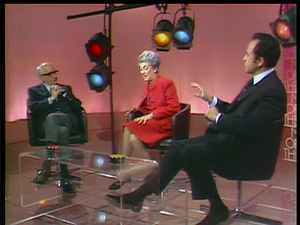
This concluding program examines the image and ethics of Congress with respect to ethical standards, misconduct, abuse of Congressional junkets, military commissions, nepotism, conflict of interest in terms of outside business, and loopholes in campaign contribution laws. Capitol Hill news commentator and host Joseph McCaffrey explores these issues with U.S. Senators, Representatives, political specialists, and Congressional newspaper writers. Appearing in The Ethics and the Image are: U.S. Senators William Proxmire (D Wisconsin), John S. Cooper (R Kentucky), Maurine Neuberger (D Oregon), Congressman Adam Clayton Powell (D New York), Richard Bolling (D Missouri), Stanly Tupper (R Maine), John Menagan (D Connecticut), Dom Bonafede of the Washington bureau of the New York Herald Tribune, Walter Pincus, Congressional reporter for the Washington Star, and Dr. Royce Hanson, political scientist at American University. Among the dissenting views given are: Senator Cooper, a minority member of the Senate Rules Committee which conducted the Bobby Baker investigation, says the case has caused a great many people over the century to wander if the Congress, members of the Congress, observes ethical standards. They question whether or not we have conflicts of interest. Theres no question that this has cast a shadow over Congress. Senator Proxmire, believes that Congress has a good image as compared to the image its had in the past. I think most people have respect for Congress. Congressman Bolling, an advocate of Congressional reform, declares that Congressmen who have private law practices spend more time practicing law and Im sure get much better pay for the practice of law than they do in their activities in Congress which is disadvantageous in two ways: its certainly an ethical problem, and number two, the people of their district and the people of the United States are deprived of their full time services. Congressman Powell, whos been criticized for having his wife whose residence is in Puerto Rico on his payroll, counters that while its claimed 130 relatives are on the House payroll, We dont know the Senate because the Senate isnt honest. They hide their payroll and the public doesnt know. So I believe until we pass a flat law abolishing all relatives not only on their staff, but other staffs and committees, that we should go along the way were doing it. Congressman Monagan asserts, I think that in all this area (ethics) the most important factor is the conscience of the individual member of Congress. You cant legislate morality. You can make all the rules in the world. There are a million ways that any individual could get compensation for doing a certain thing if he wanted to. The ingenuity of the human mind is without limit, and all these things could be surmounted so that it is a question of what the individual himself thinks is proper. Mr. Bonafede, who recently completed a series on Congressional ethics, talks about a number of instances where Congressmen were involved in law cases that he contends were a conflict of interest and he elaborates on the involvement of Congressmen who have themselves or their families in part ownership of broadcasting stations. Mr. Pincus discusses the various loopholes in the laws governing campaign contributions. (Description adapted from documents in the NET Microfiche) Covering the broad spectrum of our nation's legislative branch, "The Changing Congress" explores with interviews, commentary, film excerpts, and on-location coverage the colorful history of Congress, its evolution, development, problems, achievements, operation, inner workings, image, performances, relationship with other government branches, its function as the representative body of the American people, and future courses. The Changing Congress scrutinizes where the power lies in Congress, Washington life as seen through the activities of a Senator and Representative, the power structure and hurdles that must be surmounted for legislation to pass, the pros and cons of Congressional probes, influences of the constituency and lobby groups on Congress, the increasing dominance of the executive branch with respect to legislation, the extent to which Congress shapes foreign affairs, and proposals for Congressional reform. The series host, John F. McCaffrey, dean of Washington television news correspondents and award-winning commentator, has been an observer of the Capitol Hill scene for more than twenty years. Mr. McCaffrey started in news broadcasting while working as a newspaper reporter prior to World War II. Following active service, he joined the Washington bureau of CBS. Later, he served as Washington editor for Mutual Newsreel of the Air. In 1954, he started his own Washington bureau, serving mid-western radio and television stations. Besides appearing on television, Mr. McCaffrey hosts, "Today in Congress," the only daily radio program devoted to Capitol Hill happenings. A lecturer and author of political affairs, Mr. McCaffrey is a two-time winner of the Washington chapter of the Academy of Television Arts and Sciences Emmy Award. The Changing Congress is a 1965 production of National Educational Television. It consists of 9 half-hour episodes that were originally recorded on videotape. (Description adapted from documents in the NET Microfiche)
Sign in to order prints, canvas, and more of this work. Browsing and full-resolution downloads stay free.