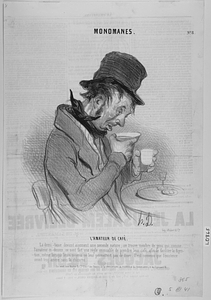
- D'la bière jamais....... il n'y a que l'absinthe pour remonter un homme!....
Trustman, Benjamin A., Trustman, Julia M. · 1863
Two very drunk men are sitting and drinking in a bar. It can be assumed that this is one of the first prints Daumier produced after his dismissal from the CHARIVARI before he was hired back on December 18,1863. For three years he was focussing on oil paintings and drawings. According to Provost this restaurant could be the Café Baudequin located on Boulevard des Batignolles in Paris. Many artists like Zola, Cézanne etc. were frequent guests there. LES CHINOIS DE PARIS, a series of 2 prints which appeared in December 1863 in the CHARIVARI. ABOUT ABSINTHE. From the Fairfield County weekly of 2.2.2006, the following observations have been compiled by D. N. Walter about Absinthe. “It is fascinating to learn what a devilish role that absinthe--a liqueur suffused with the psychoactive herb wormwood, among others--played in some of the most prominent scandals of the 19th century worlds of art and literature. Vincent Van Gogh, for example, consumed absinthe on the evening that he famously cut off part of his own ear after arguing with Paul Gauguin in Arles. Absinthe also fuelled the mad escapades of French poets and lovers Arthur Rimbaud and Paul Verlaine. When the younger Rimbaud spurned Verlaine's advances one absinthe-besotted evening in Brussels, Verlaine shot and wounded Rimbaud, and was subsequently imprisoned for several years. Once released from prison, Verlaine swiftly returned to drinking absinthe, and he later became a grotesque object of pity in Parisian cafés, where he pursued absinthe unto death. Oscar Wilde, who drank absinthe heavily after being released from prison in England, also wrote, "After the first glass you see things as you wish they were. After the second, you see things as they are not. Finally, you see things as they really are, and that is the most horrible thing in the world." The word absinthe is derived from the Greek apsinthion , meaning undrinkable. This description stems from the bitter taste of the plant wormwood--the primary psychoactive ingredient in absinthe--whose use in wines and other alcoholic elixirs dates back to ancient Greece. French chemists and physicians who studied absinthe to determine why it had such a deleterious effect upon its addicts discovered that the principal psychoactive ingredient in wormwood oil is thujone, an isomer of camphor, which was an early anaesthetic. Scientists also discovered, however, that some of the other herbs used to mellow the taste of absinthe--such as anise, melissa (a type of mint) and hyssop--also had stupefying effects and contributed to the drink's injurious effects.
Sign in to order prints, canvas, and more of this work. Browsing and full-resolution downloads stay free.