Conversations with Eric Hoffer; Automation
KQED-TV (Television station : San Francisco, Calif.) · 1964
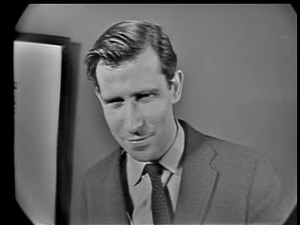
James Day interviews longshoreman philosopher Eric Hoffer. Mr. Hoffer examines the role that works plays in self-esteem as well as the effects of growing automation upon this self-esteem. He comments on the basic human need in all societies, in every period of history, for self-realization. It is, he feels, the feeling of worth derived from productive activity whether it be manual labor or the creation of art, literature and philosophy. Mr. Hoffer points out that early science grew out of Western man's conception of God as "a master scientist," and that Leonardo da Vinci, for his art, investigated anatomy and became interested in science because he believed it was "God's work." He then traces the development of machines from early civilization to what he terms, "present day over-mechanization and automation." Today's fast-growing automation and shrinking labor market is turning early man's dream of luxury and leisure into a nightmare. Unemployment among workers is outstripping the ability of today's economy to supply jobs for the unskilled. Mr. Hoffer cites current unemployment figures and projects them into the future, commenting that "when man is cut off from the chance to exercise his skills, he loses his confidence, his joy for life, and his sense of worth. Where you have people without a sense of usefulness, you have a potentially explosive situation ideal for the growth of hatred, bigotry and racism." x0BHe illustrates by discussing the John Birch Society which, in his words, is "an organization of retired businessmen and generals, cut from their life work, who channel their energies into destructive areas." Mr. Hoffer does not believe that there is a demand today for the artist and the intellectual as there was in earlier societies. However, he does believe that the energies and emotions of men freed from manual labor can give rise to a rebirth or a discovery of the creative potential that exists in the masses, the workingman and in each individual. Partially in jest, Mr. Hoffer suggests the development of a "state of unemployment" which would be run by a university and in which every resident, regardless of his age, becomes automatically registered to develop his inherent talents. He sums up his point of view by stating that only when we realize our human resources and put them to use can we become a really efficient society. (Description adapted from documents in the NET Microfiche) Eric Hoffer, philosopher and longshoreman, is interviewed in by James Day, general manager of KQED in San Francisco. In the first season of six episodes, the conversations are based on Mr. Hoffers latest book, The Ordeal of Change, published in March of 1963 by Harper and Row. Eric Hoffer works four days a week as a San Francisco longshoreman just enough to pay bills for his furnished room and meals. His main concerns are reading, thinking and writing. Mr. Hoffer has produced three books, The True Believer, The Passionate State of Mind, which is a collection of 280 aphorisms on man, and The Ordeal of Change, which states his philosophy on what history teaches us. Eric Hoffer was born in the Bronx, N.Y., in 1902, the song of a German cabinetmaker. His Mother died when he was seven-years-old, and shortly thereafter, he lost his eyesight. Nine years later, Mr. Hoffers sight was restored and he began to read voraciously. In the early 1920s, he moved to the West Coast where he worked at different types of laboring jobs while continuing his main preoccupation reading. In the late 1930s, Mr. Hoffer began writing and by the early 1940s, he was sending his efforts to publishers. The True Believer, published in 1951 was his first success. Mr. Hoffer is interviewed by James Day, general manager of station KQED, San Francisco. Mr. Day is host for the stations popular interview series Kaleidoscope. He is a former deputy director of Radio Free Asia and former public affairs director of KNBC in San Francisco. He was graduated from the University of California in 1941. Conversations with Eric Hoffer is a 1963 production of KQED, San Francisco.The 12 half-hour episodes that comprise the series were originally recorded on videotape. (Description adapted from documents in the NET Microfiche)
Sign in to order prints, canvas, and more of this work. Browsing and full-resolution downloads stay free.