Men Who Teach; Llyod Reynolds and William Geer
National Educational Television and Radio Center · May 14, 1968
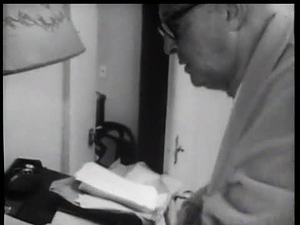
Reynolds: Lloyd Reynolds, 66-year-old calligrapher and art historian at Reed College, is a man who has made students care about both the intricacies of the alphabet and about the meaning of their times. Now in his last year of teaching at the Portland (Oregon) College, Reynolds gives lectures in art history that attract overflow audiences. His appeal is perhaps demonstrated in the following incident captured here on film: During a lecture on Dutch painter Pieter Brueghel, Reynolds draws an analogy with today?s hippies, and says: ?The Pilgrims were the original hippies in this country. They were the most unpatriotic, irreligious people in England.? His point is that the hippie is not the creation of a bastard culture, but represents a ?solid tradition in Western culture.? To the students at Reed College, Lloyd Reynolds is a man who can ?connect.? A former student, dedicating his book of poems to Reynolds, calls him ?an angry man ? one who is angry at folly and war.? His lectures reflect this anger and this concern. In a course on 19th century poet William Blake, Reynolds fuses the man of letters, the artist, and the social critic. And he adds a characteristic Reynolds touch ? the sense of Blake?s graphic quality. It is this interest that sense of Black?s graphic quality. It is this interest that permeates his teaching of calligraphy, the art of handwriting. Reynolds uses the teaching of this subject both as a discipline and as a history course. The history of the alphabet leads into Chinese characters and their meaning. Or, as Reynolds? former student Lou Welch recalls, Reynolds ?brings you back to the absolute fact of what you?re doing.? A favorite device of Reynolds is to challenge the liberal arts student by saying ?You don?t even know what a book is.? By stressing the way in which it is made, Reynolds make a book a more immediate thing,? prompting Welch to call him ?a Zen master in a Western way.? The camera ranges from lecture hall to study, as Reynolds illustrates the italic cursive writing style, expounds on art history and calligraphy, and views life through his refined focus. Background Lloyd Reynolds, professor of calligraphy and art history at Reed College. A native Minnesotan, he received a BS degree in forestry and botany from Oregon State College, worked for a year as a timber cruiser, then returned to college, gaining a BA and MA from the University of Oregon. In 1929, he became a teacher of English literature before moving into art history. He was instrumental in persuading Portland Art Museum to hold the first major American exhibition of a historical survey of calligraphic work in 1958. Reynolds? catalogue for the show has since been shown around the world. He received a Ford Foundation grant to revise his ?Italic Exercise Book? and see it through its second printing. In his last full year of teaching, Reynolds curtailed instruction to finish work on a second text, ?Italic Handwriting Manual.? ?Man Who Teach: Lloyd Reynolds? is a production of National Educational Television. Producer: Lane Slate. This program was made possible by a grant from the Celanese Corporation. Geer: William Geer, lecturer in modern civilization at the University of North Carolina, is a man who confronts traditional southern attitudes with intellectual impudence and personal verve. This half-hour program depicts him as ?a genial Mr. Chips and a terrible Mr. Hyde, who will make them (students) laugh, make them rage.? His method, seen in both dramatic and contemplative moments, is discussed during the program by several of his students. (?He turned my mind upside down.? ?He just made me a little more critical of myself, of what I had been taught, about the racial issue, and about the general south itself and its Southern Baptist ideas.?) The subject of modern civilization, ranging from the ?birth of Western though to the headlines in this morning?s newspaper,? offers an ideal base for Geer?s liberalizing attitudes, and he takes on a variety of regional dragons: On war: ?Isn?t it great? We can take one bomb now and pfft blow up a whole city ? Can you think in terms of 8 ? million people dying?? On the Negro: ?Now there?s a problem. Why didn?t those men working beside you even have a high school education? I expect some of them hadn?t finished the third grade. Why? No incentive? You mean it?s just human cussedness, or do you think there are some problems involved in it?? On science: ?And so we developed in Western civilization that great cant, that great worship of the new god, science. And when I think of the word, I ? bow down three times ... and then I feel that my devotions for the day are in better shape than they were.? The approach is unorthodox, but Geer is worried only about the effect. For he explains that he cannot bear a dull class. Instead, buy pursuing a question ?to its logical end,? he may watch ?the lights turn on? in the eyes of an attentive class. It is this method that prompts him to be described during the program as ?a missionary in a people?s university ? a teacher trying to lead an inner migration from the beloved past to the uncertain present.? Background William Geer, lecturer in history and modern civilization at the University of North Carolina in Chapel Hill. A native of South Carolina, Geer graduate from The Citadel, a military academy in Charleston, and received his MA in 1936 from Emory University. Before joining the faculty at Chapel Hill, Geer taught at The Citadel, Furman University, the United States Military Academy, and George Washington University. He has also been a historian in the State Department in Washington, DC. At North Carolina, he has twice won the Tanner?s award for excellence in the teaching of undergraduate students. The author of ?the Governments of Major Foreign Powers? and ?Contemporary Foreign Governments,? a widely-used college and university text, he was at work on a biography on the late North Carolina governor O. Max Gardner when this film was produced. ?Man Who Teach: William Geer? is a production of National Educational Television, made possible by a grant from the Celanese Corporation. Producer: Earle Luby. Narrator: Ben Park. (Description adapted from documents in the NET Microfiche) A series of hour-long documentary episodes about the nations master teachers produced by National Educational Television. Called Men Who Teach, the series was made possible by a $250,000 grant from the Celanese Corporation. In a joint announcement by John F. White, president of NET, and John W. Brooks, president of Celanese, the series was characterized as a distinguished and dramatic portrait of the role of the university teacher in America. Mr. White said: Industry has a tremendous stake in education and, I am convinced, in educational television. We are grateful to Celanese for this opportunity to forge another link between business, NET, and the academic world, allowing the television audience to encounter the personality and to sense the dedication of some of our great university teachers. Mr. Brooks observed that Contrary to the beliefs of many young people today, there is not very much difference between the goals or the methods of scientist in the universities and those in private industry. Celanese intends this series to be a tribute to the many inspired teachers who set the standards of academic excellence in the US and contribute so much to the quality of our culture. We believe NET is the logical showcase for this distinguished and dramatic portrait of great teaching, Mr. Brooks continued. Educational or public television is essential as a medium for those important messages which may be too specialized for the format and cost structure of commercial TV. Men Who Teach is such a message, and Celanese is proud to be associated with it. Each episode deals with a different university or college teacher selected on the basis of extensive research among a representative cross-section of institutions throughout the United States. Time Inc., and the Danforth Foundation have made available to NET their continuing research, undertaken by Time magazine for its April 1967 cover story about teachers and by Danforth in its Harbison Awards program for distinguished teachers. Subjects selected include Gerald Holton, professor of physics, Harvard University, Norman Jacobson, professor of political science at the University of California, Berkeley; Lloyd Reynolds, art historian and calligrapher at Reed College in Portland, OR; Abraham Kaplan, professor of philosophy at the University of Michigan; Howard Mitchell, professor of urbanism and human resource at the University of Pennsylvania and Director of the Universitys Human Resources Programs; and William Geer, professor of English at the University of North Carolina. Each episode takes the audience into the classrooms and laboratories with the teacher, showing him at work and providing insights into his views about the process of education. The cameras also visit the teachers home, and seek out the reaction of his students in dormitory bull sessions. The 5 episodes that comprise this series were originally recorded on film and distributed on videotape. (Description adapted from documents in the NET Microfiche)
Sign in to order prints, canvas, and more of this work. Browsing and full-resolution downloads stay free.