The Joy of Effort
McKenzie, R. Tait (Robert Tait), 1867-1938 · [1912?–1940?]
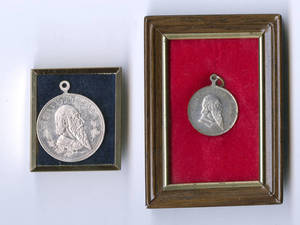
This lantern slide shows the bas-relief “The Joy of Effort,” one of R. Tait McKenzie’s best known pieces. It captures the strain of the hurdles and the sprinters in their relaxed look, the sense of competition, and the sheer joy of competing. This sculpture was commissioned by the United States Olympic Committee and entered in the art competition of the 1912 Olympic Games in Stockholm. It was presented to the King of Sweden and placed permanently in the stadium wall of the Games. The origins of McKenzie’s inspiration for “The Joy of Effort” are unclear. One story claims that McKenzie was inspired by his study of athletes on Franklin Field during the Penn Relays at the University of Pennsylvania. The other version, written by Mrs. McKenzie, claims he was inspired while on an ocean voyage. Springfield College owns several bronze sculptures by McKenzie, including “The Competitor” (1906), “The Relay Runner” (1910), “The Joy of Effort” (1912), “The Boy Scout” (1914), and “The Plunger” (1925). As of 2013, the Joy of Effort was on display in the Marsh Memorial building. Additionally, the college owns three medals designed and created by McKenzie. These include “The Luther Halsey Gulick Memorial Medal” (1923), “The Shield of Athletes” (originally “The Olympic Buckler,” 1932), and “The Three Punters” (1932-1933). Three-inch bronze replicas of McKenzie’s “Joy of Effort” are given to the recipients of the College’s Tarbell Medallion, first awarded in 1935. In 2008, Springfield College hosted an exhibition of McKenzie’s work, entitled “R. Tait McKenzie (1867-1938): Foremost Sculptor of Sport Art.” In 1913, Springfield College awarded McKenzie an honorary degree. That same year, McKenzie donated four photographs of his most famous works to the Springfield College: “The Competitor,” “The Onslaught,” “the Athlete,” and “The Joy of Effort” (depicted here). The school, now known as Springfield College, hung these works in the recently-built Marsh Memorial Library and wrote of his donation, “This choice gift is a reminder of the many walls-spaces in the larger rooms and galleries waiting for really meritorious pictures.” It is not known at this time where these prints are. Robert Tait McKenzie (May 26, 1867 – April 28, 1938) was a Canadian-born sculptor, doctor, soldier, physical educator, and athlete. His childhood friend was James Naismith, the inventor of Basketball, with whom he attended McGill University in 1885. After graduating in 1892, he developed his own medical practice, taught anatomy at McGill, and served as the personal family physician of the Governor General of Canada. In 1898, McGill appointed him the Medical Director of Physical Training. To escape from his duties, McKenzie turned to art. While he first experimented with watercolors, he eventually turned to sculpting athletes. In 1904, McKenzie accepted a job as Director of the Physical Education Department at the University of Pennsylvania. This role came with the opportunity to test his theories on health and athletics. While in Philadelphia, he worked closely with Lord Robert Baden-Powell, founder of the Boy Scouts. During 1907, McKenzie met and married musician and poet Ethel O'Neil. At the outbreak of World War I, he enlisted with the Royal Army Medical Corps and was given the commission of Lieutenant (and later Major). After the war, McKenzie returned to his position at the University of Pennsylvania, but ultimately left in 1930. In 1931, he received "The Freedom of Almonte," an award of recognition from his hometown. McKenzie created over two hundred works of art seen around the world today. For more information on R. Tait Mckenzie, see: https://springfield.as.atlas-sys.com/agents/people/720. Text on border reads, "The Joy of Effort; R. Tait McKenzie."
Sign in to order prints, canvas, and more of this work. Browsing and full-resolution downloads stay free.