Tine Kindermann
Yiddish Book Center (Allie) · December 30, 2010
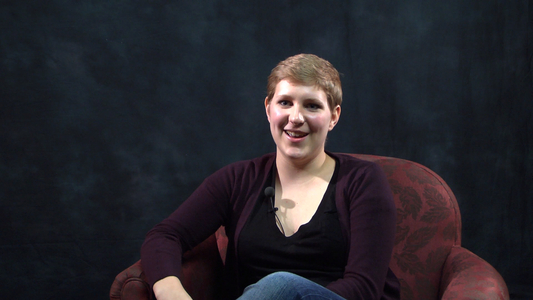
Tine Kindermann grew up in Berlin, West Germany. She lived in a suburban area that was quiet and filled with greenery. Her parents had also grown up in Berlin during the war. Tine went to elementary school near her home, but her high school was in a different part of Berlin. Following high school, Tine held a three year apprenticeship where she began to develop her skills as an artist. In 1988 Tine went to a free outdoor 8 week world music festival in Berlin. In hopes of bringing her mother back an album of klezmer music, Tine went backstage after a Klezmatics concert and met Frank London, her future husband. Tine recalls their first meeting and their courtship briefly during the interview. During her time outside of school, Tine worked as a musician and visual artist. 25 years of her work was in the theatre where she painted and designed sets. Her interest in world music, inherited in some ways from her parents, brought her to Yiddish song. Before setting in the United States, Tine traveled to see Beyle Gottesman to brush up on her Yiddish pronunciation for a recording she was helping a friend with. Her connection to Yiddish developed, and in 1992 she attended her first Klezkamp. When she began to get involved with Klezkamp she found the environment welcoming to her artistic and personal interests. After traveling back and forth between Germany and the states, Tine finally settled in the United States in 1994. The latter half of the interview focuses on Tine's non-Jewish upbringing. Tine's family history is an interesting one, and she divulges some of the details of her familial past towards the middle of the interview. She discusses what it was like to have one grandfather who was a resistor and one grandfather who was a Nazi. She takes the time to detail how her reistor grandfather was abusive and her Nazi grandfather joined the party in hopes of exhibiting art. These stories of her family's past have developed her interest in the unseen elements or gray areas of experience. Tine goes on to detail her current projects, while interlacing stories of her conversion process, her family's choice to have a Jewish home, and her children's conceptions of their identities. The interview ends focusing on Tine's experience as a non-Jewish participant in klezmer and Yiddish related cultural activities as well as her work as a German folk musician, artist, and mother. To learn more about the Wexler Oral History Project, visit: http://www.yiddishbookcenter.org/tell-your-story To cite this interview: Tine Kinderman Oral History Interview, interviewed by Pauline Katz, Yiddish Book Center's Wexler Oral History Project, KlezKamp 2010, December 30, 2010. Video recording, http://archive.org/details/TineKindermann30december2010YiddishBookCenter ( [date accessed] )
Sign in to order prints, canvas, and more of this work. Browsing and full-resolution downloads stay free.