Karen Encarnacion
Yiddish Book Center (Chad) · October 12, 2012
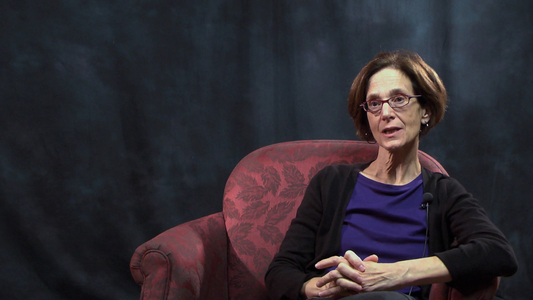
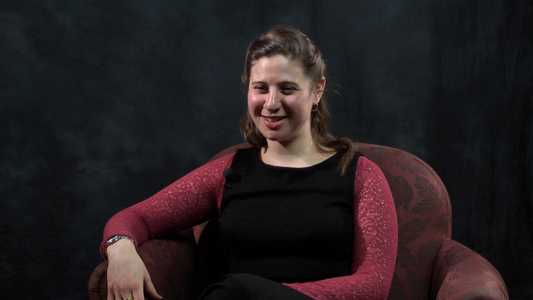
Karen Encarnacion, native of New York City from a mixed Filipino-Jewish family, was interviewed by Agnieszka Ilwicka on October 12, 2012 at the Yiddish Book Center in Amherst, Massachusetts. Karen begins the interview discussing her family background, focusing on the multi-cultural and multiethnic nature of her family. Her father is from the Philippines and immigrated to the United States when he was around twenty years old during the 1950s. Her mother comes from a Jewish family of Eastern European background with origins in Belarus and Poland. Karen then moves on to talk about her experience growing up in a mixed household that moved around the country frequently due to her father’s employment with the United States military. She describes how her home was not very Jewish and how her father wanted her and her siblings to be raised Catholic. Karen recalls celebrating Catholic holidays and receiving a Catholic religious education, adding that it was only when she was older that she became more interested in learning about her Jewish background and involved in Jewish celebrations. Describing her neighborhood as “diverse and often multiethnic,” Karen discusses living in Boston for eight years during the early 1970s and the circumstances surrounding the public school system. Reflecting on her mixed Jewish-Filipino background during the rising tensions in Boston, Karen further explains what it was like being caught between not being black and white, noting: “it made me very sensitive to how people were defined in those circumstances and how they were treated based on the way they got defined.” This experience made her feel an affinity towards different women of color and other groups when she started college. She tells a particular story of how her advisor at Mount Holyoke College took her under her wing and stressed to her that the history of the Philippines is also connected and related to the histories of Latin American and Iberian countries. During her undergraduate years she joined the cultural group, La Unidad, recalling how it was a space where she very much felt like she belonged. Framing her sense of Jewishness through the lens of her mixed background, she notes: “It was something that my family was but didn’t feel like it was something which I was a part of.” She shares a particular reflection on how her interest in Yiddish originates from her grandmother who spoke Yiddish, adding that she knows that Yiddish and Yiddish culture shapes her mother’s family’s sense of self as Jews but can’t quite describe it or why. She then moves on to explain how questions surrounding her Jewishness didn’t surface until she was to be confirmed in the Catholic Church and didn’t want to. She shares a particular anecdote about reading young-adult Holocaust literature when she was a teenager and explains how reading about those experiences allowed her to come to a space where she could understand her Jewishness, and learn about her father’s experiences as a young boy in the Japanese-occupied Philippines during World War Two. Towards the end of the interview, Karen reflects on her Jewish identity and states that she doesn’t see herself as a “good Jew” because she doesn’t belong to any community nor is steeply involved in cultural practices. Rather, she sees her connection to Judaism on a deeply personal level: “the way that Judaism affects me most profoundly is thinking about the kind of person I want to and strive to be in the world. Those values affect the way that I interact with people.” She concludes the interview expressing her desire to become proficient in speaking, reading, and writing Yiddish in order to understand more fully the existence of life within the Yiddish language. She is particularly interested in the mission of the Yiddish Book Center’s Wexler Oral History Project to gauge how Yiddish culture and values are transmitted over time and appreciates how it allows for a number of voices and views to be seen and heard. To learn more about the Wexler Oral History Project, visit: http://www.yiddishbookcenter.org/tell-your-story To cite this interview: Karen Encarnacion Oral History Interview, interviewed by Agnieszka Ilwicka, Yiddish Book Center's Wexler Oral History Project, Karmazin Recording Studio, Yiddish Book Center, October 12, 2012. Video recording, https://archive.org/details/KarenEncarnacion12oct2012YiddishBookCenter ( [date accessed] )
Sign in to order prints, canvas, and more of this work. Browsing and full-resolution downloads stay free.