Digital Commonwealth — Boston Public Library
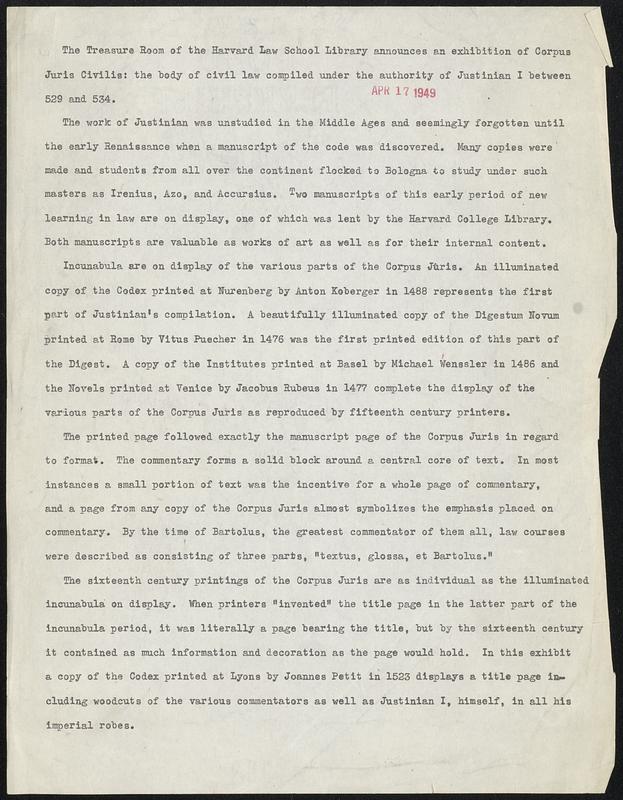
The Treasure Room of the Harvard Law School Library announces an exhibition of Corpus Juris Civilis: the body of civil law compiled under the authority of Justinian I between 529 and 534. The work of Justinian was unstudied in the Middle Ages and seemingly forgotten until the early Renaissance when a manuscript of the code was discovered. Many copies were made and students from all over the continent flocked to Bologna to study under such masters as Irenius, Azo, and Accursius. Two manuscripts of this early period of new learning in law are on display, one of which was lent by the Harvard College Library. Both manuscripts are valuable as works of art as well as for their internal content. Incunabula are on display of the various parts of the Corpus Juris. An illuminated copy of the Codex printed at Nuremberg by Anton Koberger in 1488 represents the first part of Justinian's compilation. A beautifully illuminated copy of the Digestum Novum printed at Rome by Vitus Puecher in 1476 was the first printed edition of this part of the Digest. A copy of the Institutes printed at Basel by Michael Wenseler in 1486 and the Novels printed at Venice by Jacobus Rubeus in 1477 complete the display of the various parts of the Corpus Juris as reproduced by fifteenth century printers. The printed page followed exactly the manuscript page of the Corpus Juris in regard to format. The commentary forms a solid block around a central core of text. In most instances a small portion of text was the incentive for a whole page of commentary, and a page from any copy of the Corpus Juris almost symbolizes the emphasis placed on commentary. By the time of Bartolus, the greatest commentator of them all, law courses were described as consisting of three parts, "textus, glossa, et Bartolus." The sixteenth century printings of the Corpus Juris are as individual as the illuminated incunabula on display. When printers "invented" the title page in the latter part of the incunabula period, it was literally a page bearing the title, but by the sixteenth century It contained as much information and decoration as the page would hold. In this exhibit a copy of the Codex printed at Lyons by Joannes Petit in 1523 displays a title page including woodcuts of the various commentators as well as Justinian I, himself, in all his imperial robes.
[ca. April 1949]
[Information from item housing] Manuscripts
🔒
Order museum-quality prints
Sign in to order prints, canvas, and more of this work. Browsing and full-resolution downloads stay free.