People are Taught to be Different; Cultural Patterns of Marital Sanctions
KUHT-TV (Television station : Houston, Tex.) · 1958
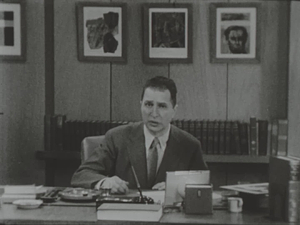
The sharp differences in marriage rituals and requirements of the people of three different societies are shown. The groups chosen as examples are the Americans of Continental United States, the Bantu of Africa, and the Muria Tribes of India. A descriptive narration presented against a background of original music clearly outlines each example in terms of the basic motive behind the selection of marriage partners, the operations of the rituals that join them, and the values that guide their relationships as husband and wife. Features of particular interest include the sharp differences in the way mates are selected, points of emphasis in each ritual, and the hazards of marital adjustment that are foreshadowed. Wedding scenes of the Muria are especially vivid, and the close of this group?s ritual stresses all the qualities of surrender to group values and mores for which the Muria are known. (Description adapted from documents in the NET Microfiche) People are Taught to be Different is a series of films representing a new departure in educational telecasting. From anthropology, social psychology and sociology, it draws case materials that dramatically portray the different ways children are brought up and personality is shaped throughout the world. Against a stylized background of primitive village and modern American life, folkways of childbirth, child-rearing, puberty rituals, courtship behavior, marriage rituals, institutional development, religion, medicine and death rituals are interpreted through the medium of modern dance. The sets, dances and music, create specifically to complement the explanations of the various groups and topics, combine to give, the viewer a you are there perspective. The material is presented by Dr. Henry Allen Bullock, professor of sociology and Chairman of the Graduate Research at Texas Southern University. He explains how and why human beings are made into different kinds of persons in different parts of the world. The 12 episodes that comprise this series each run about 30 minutes. (Description adapted from documents in the NET Microfiche)
Sign in to order prints, canvas, and more of this work. Browsing and full-resolution downloads stay free.