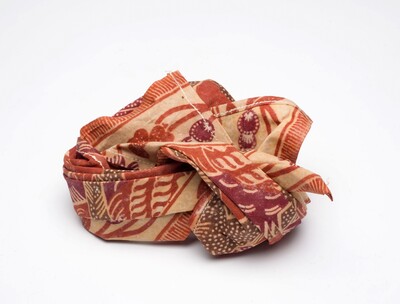
Cotton shoulder cloth with ornament in doubleikat
Unknown artist
Along the edges a standing female figure. The ends have a broad border of 12 cm. wide with star figures.Korn gives on page 17 an illustration of a doubleikat with this pattern and gives it the name gringsing putri dedari (1933:12-17). Outside Tenganan one sees gringing fabrics being used at numerous adat ceremonies, e.g. at three and six month celebrations of children; the hair sacrifice; teeth filing; marriage; death and at decorations of temples. P. Wirz (1931) writes that new cloths, of which the warp threads have not yet been cut, are used at weddings. During the ceremony, the mother of the bride cuts the threads of the cloth with which bride and groom have wrapped themselves.\Now, the mother of the bride cuts the threads of the cloth with which the bride and groom have wrapped themselves. Doubleikat.\Ikat is a technique in which the threads of a fabric are first tied off, according to pattern, after which they are dipped into a dye bath. The tied off parts are not dyed. This process can be repeated a number of times, so that a multicoloured pattern is created.\ Depending on whether the dyeing process has been applied to the warp, weft or both threads, this technique is called warp-ikat, weft-ikat and double-ikat. The first is the most common.Before the threads are tied off, they are often folded over each other, both lengthwise and widthwise. With such a method, the motifs appear in mirror image.
Sign in to order prints, canvas, and more of this work. Browsing and full-resolution downloads stay free.