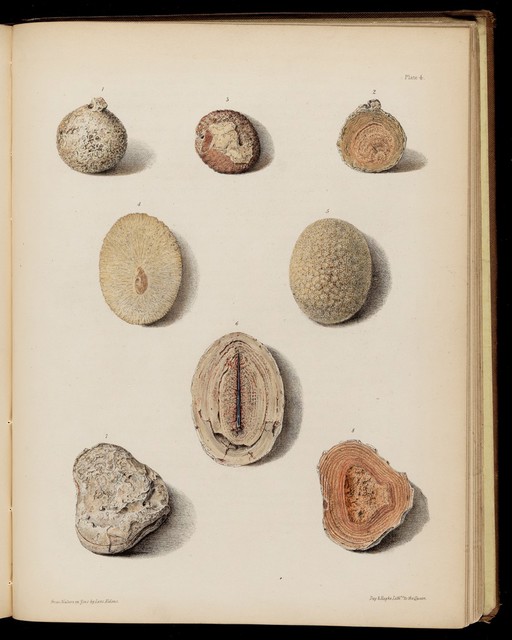
Baldder stones, figures 1-8.
Unknown artist
Text opposite Plate IV: Fig. 1. Represents the external surface of a uric acid calculus, which has apparently undergone partial solution from the use of alkaline medicines. The exterior is porous, and as it were, worm-eaten, and is covered by a thin crust of urate of soda. Fig. 2. Represents a section of the same calculus. The process at the upper part of the drawing has probably been produced by adjoining parts having been dissolved. A 168, p. 24. Fig. 3. Represents the exterior of the calculus taken after death from the bladder of Mr. Hay, who had taken alkaline medicines in enormous quantities for several years. The light brown layer, which, at one time, invested the whole of the calculus, undoubtedly owe their peculiar texture and appearance to the influence of alkalies : these layers are exceedingly brittle, and consist of impure urate of ammonia. A 184, p. 27. Fig. 4. Represents the section of a cystic oxide calculus, showing its confusedly crystalline structure. Fig. 5. Represents the external surface of the same, the projecting summits of the crystals giving to it a slightly tubercular appearance. Fig. 6. Represents the section of a very remarkable calculus. It consists of pale-coloured uric acid mixed with urate of ammonia, deposited upon a slender piece of steel, which appears to be a portion of a stilet. From the manner in which the layers of this calculus surround the nucleus, there is no reason to suppose that the piece of steel has been other substance, save the earthy phosphates upon foreign bodies in the bladder, is a very unusual occurrence. A 126, p. 20. Fig. 7. Represents the exterior of a calculus similar in appearance and composition to that of fig. 1. It exhibits, however, in a still more marked manner, the effects of a solvent action having been exerted on its surface, and it is likewise incrusted by a thin coat of urate of soda. Fig. 8. In a section of the same, showing that the concentric layers of the calculus terminate abruptly at the points corresponding with the depressions on the surface ; an effect which could only have been produced by the removed of those parts. The thickness of the outer coat or urate of soda is also seen. A 169, p.24.
Sign in to order prints, canvas, and more of this work. Browsing and full-resolution downloads stay free.


