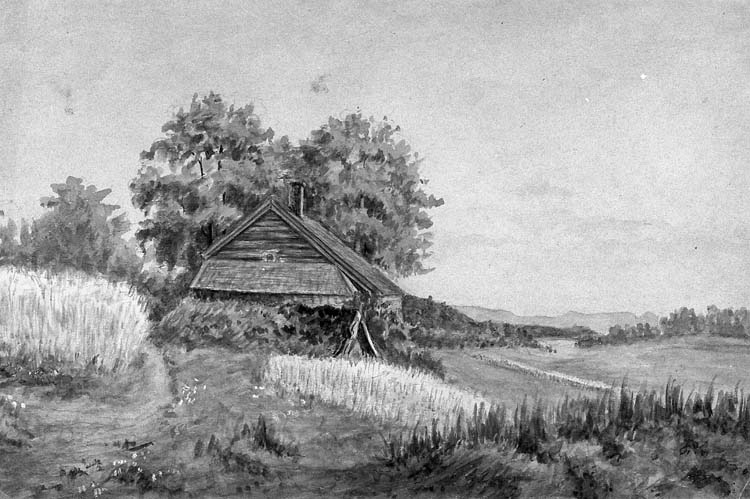
Mother Anna Katrina’s cottage at Foss Church. On the back of the original is “To Uncle P from his Ivan” trol Ivan Lönberg. The original is part of the archive of the Pontus Wikner Museum. Pontus Wikner was born in 1837 Kikerud in Valbo-Ryr, Munkedal. He was the impoverished and over-talented torpar child from the county of Chartaunian Bohuslän. Three and a half years old he learned to read. As a seven-year-old, he threw himself over biblical history in German and within a few more years saw him sitting in English and Latin grammar - all of his own interest and largely on his own. Pontus Wikner married the childhood friend Ida Weinberg in the summer of 1871. They got 2 sons, Ernst and Hugo Oscar Herman. Pontus Wikner wrote a series of books including The Narcissus saga. The Sacrifice of Culture. Among his other works, a succession of philosophical and religious conceptions and some short stories are noted: The will of my mother and the angel of Mantegna. Through childhood hardships in drafty and humid homes, Wikner suffered poor health. Towards the end of his life, he writes that he suffered from four chronic ailments. One of them - too big a heart - he does not mention without a certain pride. Pontus Wikner died in 1888, just before he was to turn fifty-one. His childhood home is now in Kaserna, at the canoe center. It is managed by Munkedal’s Hembygs Association. Source: “Munkedal. see Internet”
Unknown
Mother Anna Katrina’s cottage at Foss Church. On the back of the original is “To Uncle P from his Ivan” trol Ivan Lönberg. The original is part of the archive of the Pontus Wikner Museum. Pontus Wikner was born in 1837 Kikerud in Valbo-Ryr, Munkedal. He was the impoverished and over-talented torpar child from the county of Chartaunian Bohuslän. Three and a half years old he learned to read. As a seven-year-old, he threw himself over biblical history in German and within a few more years saw him sitting in English and Latin grammar - all of his own interest and largely on his own. Pontus Wikner married the childhood friend Ida Weinberg in the summer of 1871. They got 2 sons, Ernst and Hugo Oscar Herman. Pontus Wikner wrote a series of books including The Narcissus saga. The Sacrifice of Culture. Among his other works, a succession of philosophical and religious conceptions and some short stories are noted: The will of my mother and the angel of Mantegna. Through childhood hardships in drafty and humid homes, Wikner suffered poor health. Towards the end of his life, he writes that he suffered from four chronic ailments. One of them - too big a heart - he does not mention without a certain pride. Pontus Wikner died in 1888, just before he was to turn fifty-one. His childhood home is now in Kaserna, at the canoe center. It is managed by Munkedal’s Hembygs Association. Source: “Munkedal. see Internet”
Sign in to order prints, canvas, and more of this work. Browsing and full-resolution downloads stay free.