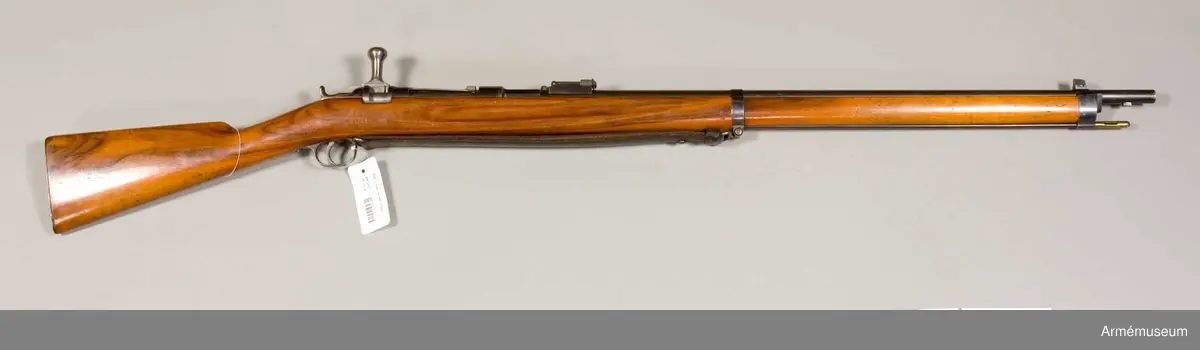
Rifle fm/1881
Unknown artist
Group E II. Number of ribs 4 pcs. Raffle rise 1 lap of 55.82 cm. The mass of the cut-off charge 4.46 g. Relative length of the race: 81 cal. Initial speed: 467 m/sec. The barrel is sprung earth and round, but has a 5 cm long chamber piece, which looks to be octagonal, but is really hexagonal. A square bayonet heel sits on the underside of the pipe 2.9 cm behind the mouth and 6.9 cm behind the latter sits on the underside an almost triangular, strong heel. The frame staircase face has double, pull-out frame, brass sight spring and 6.2 cm long foot. The latter has four “steps” and is at the rear turned out in a tip, which ends just at the front of the chamber piece, Through this tip a screw goes. The matter is not graded. On the chamber piece stands at the top a crowned C and at left the number 190. At the rear, the barrel is screwed in the pipe nut on a steel-made steam-ground box. The cylinder mechanism and the magazine are designed by Jarmann (description, see “Textbook on handguns for use at the army shooting school for officers,” Stockholm 1886, Part II, p 29. and Alm, “Firearms II,” p 168: The best description, however, is perhaps the one over the Norwegian rifle m/1884, which was similar to the Swedish fm/1881, in “Textbook on Firearms to Used at the Infantry School,” Stockholm 1892, part II, p 11. A good drawing can be found in Billmansson “Vapenläder,” part II, pl 20. On the left side of the box is the number 190. The magazine tube is of brass and holds 8 cartridges, and is located in the front. at the front it is attached to it from the bottom of the barrel, the triangular heel. The rifle has a full stock of walnut. The front has a ledge for the rear band and on each side young. 8 cm in front of the hoop a 31 cm long, at the front narrower and shallower, gut-like recess for the left hand. The brackets are of blue-iron. The baking sheet goes up just slightly in front of the heel and is restrained by two screws. The two arms of the creature are short. The posterior arm is restrained by the downhill cross screw, but the front of a crate is screwed. The rear band is 1.4 cm wide and has on the underside strong ears, which are joined by a screw. On which the front rope jaw was attached. The nose band is over the barrel 1.7 cm wide, but then becomes wider and joined by a side plate that denotes the end of the front. On the upper side, it has a grain heel, in which the steel grain’s foot is wrapped from the side. On the underside, the noseband has a front with threads provided for the scraper. The webbing is restrained by a close-fitting screw, which enters the triangular heel on the underside of the barrel. The rear belt rail is attached to the front part of the cart at the log. On the left side of the rear band stands the number 190. The scanning rod is of shiny steel and has brass heads, which are almost cylindrical, but with rounded ends. On the middle, the head is pierced by a rectangular hole, to which a threaded hole runs from the surface of the impact. At the narrow end, the scraper is threaded at a length of 0.9 cm. The rifle is intended for knitting bayonet.
Sign in to order prints, canvas, and more of this work. Browsing and full-resolution downloads stay free.