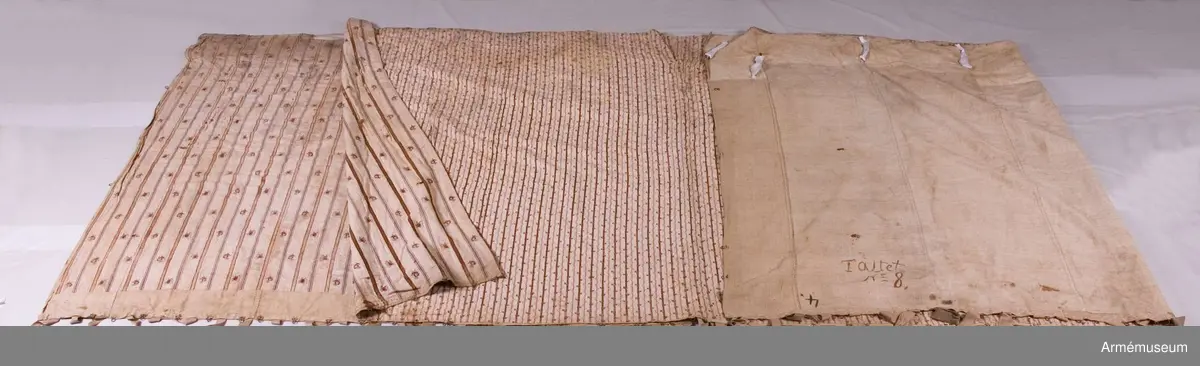
Tältvägg
Unknown artist
Group I: IV Country: Sweden Production Place and Year: Stockholm in the late 1700s. Dimensions: The walls are 1.95 m high and about 5m long longer. The total circumference is 25 m. The walls are 4 pcs. The outside in the linen and the inside in two different pattern types (textile print). The walls are T-shaped see fig. The walls of the walls form rooms with different patterns on the resp.wall. At the bottom of the outside, the linen is double folded and holes are made with buttonhole sore through which tamps are wooded to be used at the set. The bottom part of the walls that we call capes has on the inside has textile printed patterns. This is unusual because this part of the tent wall was used to dissolve sand on, to prevent the drawing of a floor. At the top, the linen is double weight and here are the cabs attached at about 10 cm distance. The printed fabric of the inside has a width of the floor. the rose pattern 70 cm and the lingon pattern 80 cm. In some places it can be seen that the walls of the tent have been patched with other motley textiles. The walls are in need of washing or cleaning. Walls 4 and 5 were exhibited during the period 29 September. - 31 January 1979. For this purpose we put on bands along the upper edge and used this edge band at the time of assembly. The digits below the dimensions on the catalogue board indicate the marking on the outer side of the linen. The label is used at the set of the tent and then combined with the corresponding figures found on the tent roof. The textile-printed patterns can be made at Sickla Kattunfabrik. I also contacted E? Hiedenmark at the Nordic Museum to get clarity on the matter. The stamp is difficult to indicate. In the sheep on the same tent part there is another signature it is completely impossible to indicate.
Sign in to order prints, canvas, and more of this work. Browsing and full-resolution downloads stay free.