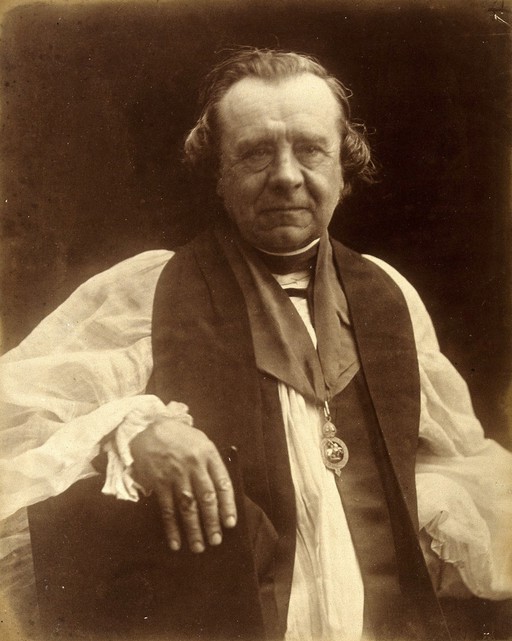
Samuel Wilberforce Bishop of Oxford by Julia Margaret Cameron
1871
Samuel Wilberforce, bishop of Oxford. Photograph by Julia Margaret Cameron. Julia Margaret Cameron was one of the leading Victorian photographers. Working at her studio at Freshwater Bay, Isle of Wight, from 1863 to 1875, she became well-known for her portraits and scenes from literature. Her sitters included the astronomer Sir John Herschel, whose knowledge of photographic chemistry helped her to get started; the naturalist Charles Darwin; the poets Tennyson and Browning; and the churchman Samuel Wilberforce, depicted here. Samuel was the son of one of the campaigners for the abolition of slavery - William Wilberforce. Samuel was appointed bishop of Oxford in 1845, and became a national figure, known both through his writings, his correspondence (his son estimated that he completed an average of 6,430 letters a year) and his appearances in pulpits as a guest preacher outside his own diocese. He was a favourite preacher of Queen Victoria and Prince Albert. He took a line on many social issues, championing the rights of factory-workers, arguing against blood sports, and supporting improved sanitation. Outside the church, he was a keen natural historian, and was a vice-president of the British Association for the Advancement of Science. With the assistance of the anatomist Richard Owen he reviewed Charles Darwin's book "On the Origin of Species" in 1860. Darwin described the review as "uncommonly clever", though Wilberforce did not accept the argument and was one of the first of many to make jokes about the idea of mankind evolving from apes. He was appointed bishop of Winchester in 1869, in which role he was photographed by Cameron. After a number of heart attacks he died in 1873, having left his mark on many aspects of Victorian England.
Sign in to order prints, canvas, and more of this work. Browsing and full-resolution downloads stay free.


