Kejsare
Unknown artist
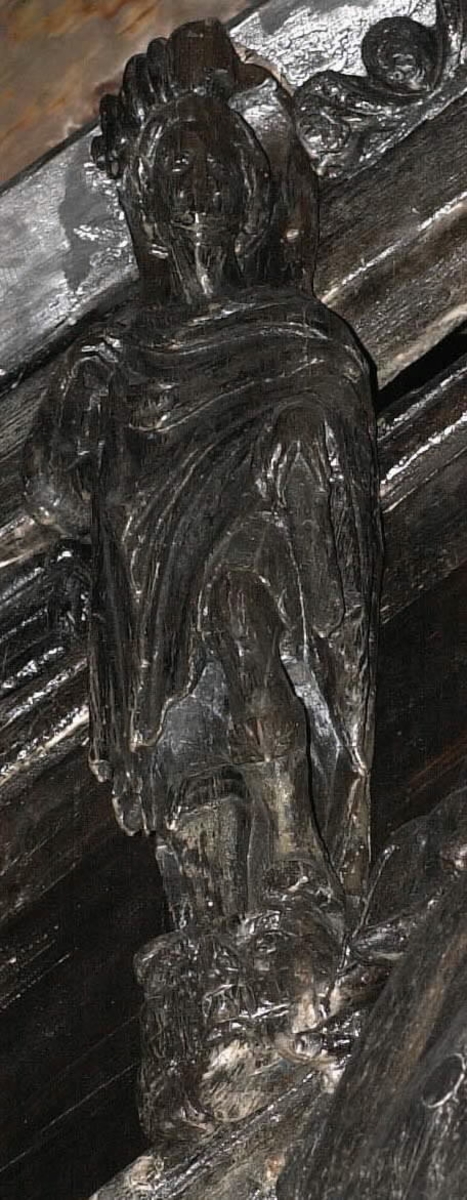
Skulptur föreställande en romersk kejsare. Ansiktet är slätrakat och på huvudet sitter en lagerkrans. Figuren är iförd en rustning, som till största delen döljs av en kejsarmantel. Manteln är draperad i rika veck över bröst, mage och lår. Huvudparten av kroppen är frontalt riktad, medan huvudet, och i viss mån även bålens övre del, är vridet mot vänster. Höger arm hålls lyftad utefter kroppen, med handen i axelhöjd. Handen har troligen hållit en lans eller dylikt. Vänster arm hålls något böjd utefter sidan. Vänster hand håller något som liknar en bokrulle. Kroppstyngden vilar på höger ben. Vänster ben är böjt, med foten placerad något högre i förhållande till högerfoten, som en följd av att underlaget sluttar. Figuren står på en kraftig sockel. Sockeln pryds av en maskaron med mänsklig fysionomi samt en snett placerad banderoll, med namninskriptionen TIBERIUS. Så gott som samtliga bokstäver är fullt tydbara. Upptill är bakstycket framdraget i en tunn "huvudplatta". Huvudplattans framkant är kraftigt förtjockad och formad till en rikt profilerad vulst med upprullade ändpartier. Skulpturens baksida är rak och uppvisar tre snedställda, olika djupt liggande fält. De tre fälten, som utgör anliggningsytor, ger skulpturen en trappstregsformad profil. Skulpturen är snidad i ett stycke, utom figurens armar och en vidhängande del av manteln som är tillverkade separat. Skulpturen är relativt välbevarad. Ytskiktet är dock slitet, med mindre defekter. Figurens ansikte är kraftigt tillplattat. Vapnet i höger hand saknas. Text in English: This is a sculpture representing a Roman emperor with laurel-wreathed head and a clean-shaven face. The figure is wearing armour which is largely hidden by the imperial mantle that is draped in rich folds over the chest, stomach and thighs. While the lower part of the body is facing front, its upper part is inclined to the left and the head is turned further to look towards the left. The right arm is bent upwards at the elbow with the hand clenched at shoulder height. The figure has probably been holding a lance or suchlike in its right hand. The left arm is raised slightly away from the body and the left hand holds something which is most likely a scroll. The weight of the body rests on the right leg, while the left leg is bent and the left foot raised slightly higher than the right foot due to the sloping plinth. The figure stands on a plinth which is decorated with a mask with human features. Across the plinth is a label on which is written TIBERIUS in capital letters. Just about all the letters are decipherable. The upper part of the back is attached to a board that extends vertically to just above the head when it bends forward at an angle of approximately 45 degrees.The front edge of the head board is heavily thickened and shaped like a richly profiled bulge with rolled-up ends. The back is not one level area but is divided into three flat surfaces at different levels in order to facilitate its attachment to the beak-head planking. The flat surfaces make the sculpture looks like a step-ladder in profile. The figure and the back piece are carved from one piece while the two arms and part of the cloak were carved separately The sculpture is quite well preserved, despite its worn surface and smaller defects. The figure''s face is badly damaged and the weapon in the right hand is missing.
Sign in to order prints, canvas, and more of this work. Browsing and full-resolution downloads stay free.