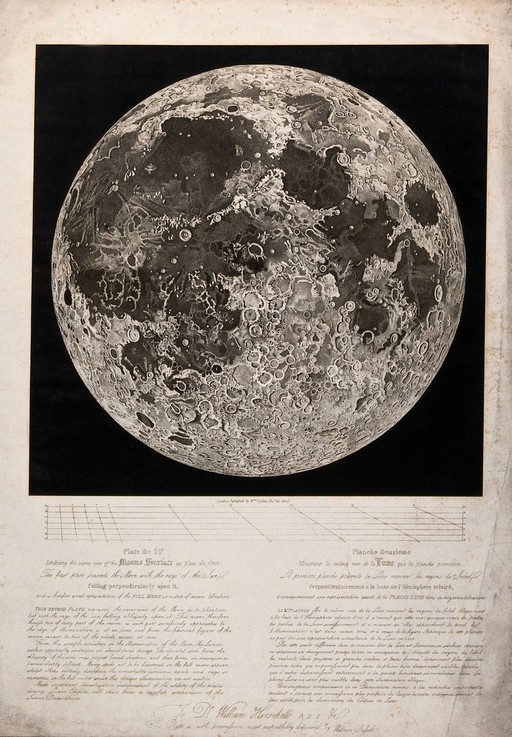
The moon, viewed in oblique sunlight. Stipple engraving, 1806, by J. Russell after himself.
John Russell · 1806
Lettering: Plate the 2nd. exhibiting the same view of the Moon's surface as plate the first. The lettering is repeated in French. Lettering continues: The first plate presents the moon with the rays of the sun falling perpendicularly upon it, and is therefore a real representation of the full moon in a state of mean libration. This second plate represents the same view of the moon as to libration, but with the rays of the sun falling obliquely upon it. This view therefore though true of every part of the moon as such part successively approaches to the edge of illumination, is at no time, and from the spherical figure of the moon cannot be true of the whole moon at once. From this simple variation in the illumination of the moon, the lunar surface appartently undergoes an almost total change: the elevated spots from the obliquety of the sun's rays project broad shadows, and their forms in consequence become clearly defined. Many spots not to be discerned in the full moon, appear, whilst others entirely disappear, the remarkable luminous points and rays so numerous in the full moon under this oblique illumination are not visible. Much important investigation independant of the utility of the plates during lunar eclipses, will arise from a careful comparison of the lunar planispheres.
Sign in to order prints, canvas, and more of this work. Browsing and full-resolution downloads stay free.


