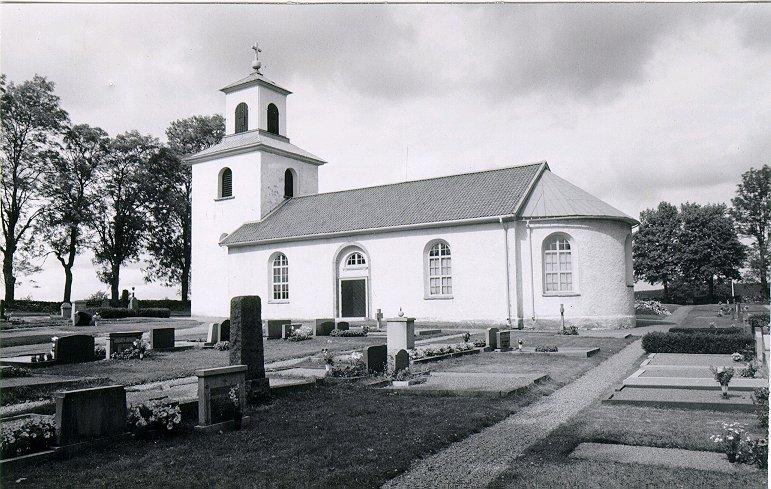
The church of Segerstad is medium sized, built in 1804 completely in simple style, rapped though built of cut stone, which is taken from the former beautiful and aged Romanesque church, which has stood at least since the 1100s. The new church was built only a few meters above the north cemetery wall. In this one had been built the engraving chamber, one of which was known for a long time. It was found at the construction of a grave but was found empty. When excavating for a new grave in 1970, the second was found. Both have been in the wall with entrance from the north. It has belonged to the Merserka genus at Seltorp. On the floor, the remains were visible after several simple wooden coffins.
Unknown artist
The church of Segerstad is medium sized, built in 1804 completely in simple style, rapped though built of cut stone, which is taken from the former beautiful and aged Romanesque church, which has stood at least since the 1100s. The new church was built only a few meters above the north cemetery wall. In this one had been built the engraving chamber, one of which was known for a long time. It was found at the construction of a grave but was found empty. When excavating for a new grave in 1970, the second was found. Both have been in the wall with entrance from the north. It has belonged to the Merserka genus at Seltorp. On the floor, the remains were visible after several simple wooden coffins.
Sign in to order prints, canvas, and more of this work. Browsing and full-resolution downloads stay free.