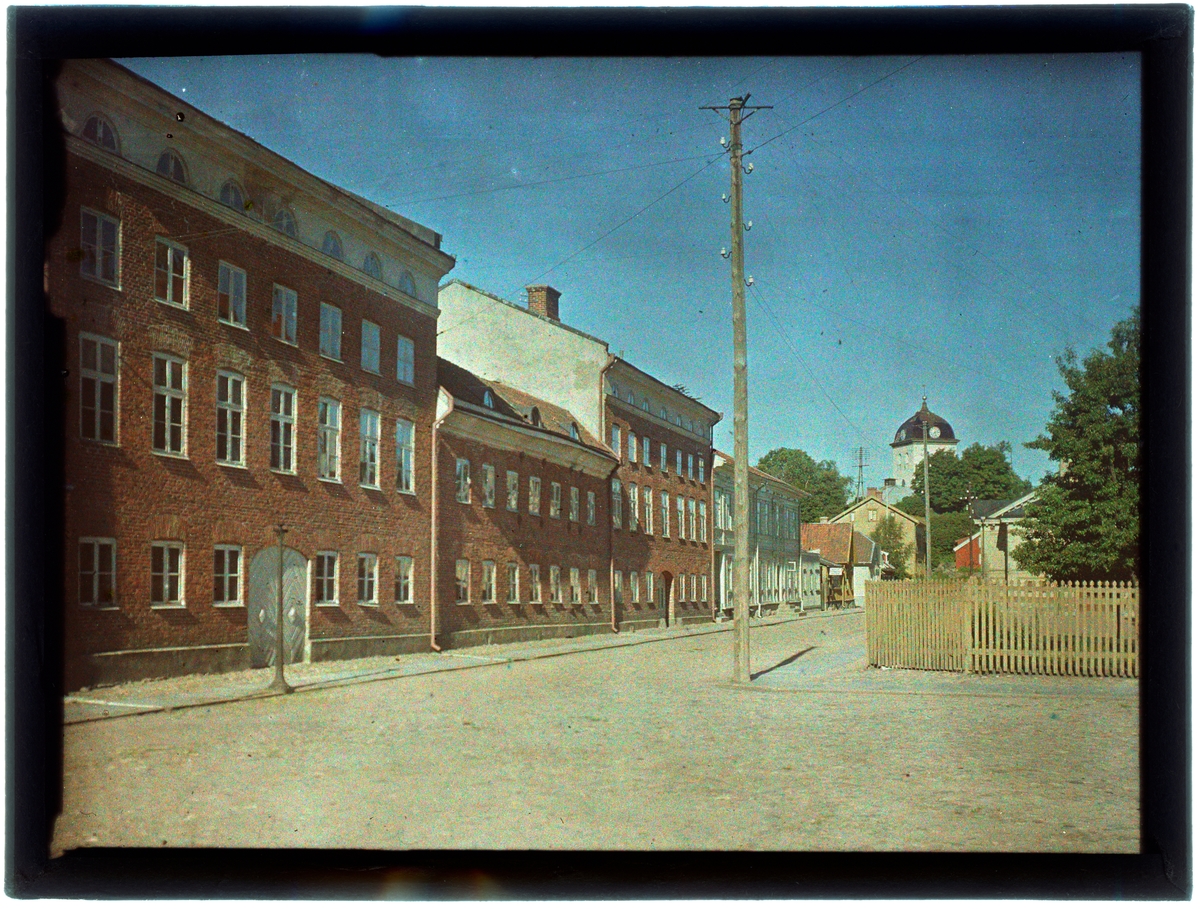
Sockerbruket, Agnebergsgatan 1928
Wernersson Cronquist, Gustaf
The motif is part of a collection of 18 autochrome sheets (glass sheets prepared with very small stained starch grains in cinnub-red, yellow-green and ultramarine blue) in format 9x12, stored in a well-made wooden schatull on whose cover is incised GWCqt Uddevalla in 1928. The box was found in the archives of the Uddevalla City Architects Office and was given to the Museum of Bohusläns in 1982. How the glass sheets ended up in the city architectural office is unknown. The unique photographs are taken by amateur photographer and stockholmer Gustaf Wernersson Cronquist (1878 - 1967), who already started to dedicate his year of photography in his 14th year. In the 1910s he became Sweden’s first colour photographer and image creation became a life task that kept him active for the 80th century. He is said to have stopped counting his pictures after reaching 50.000. What impresses the most is nevertheless the extensive lecture tours conducted by Cronquist. He started to cock around as early as 1900 and was out about 125 days a year. The final figure is not below 6.000. The lectures contained the most diverse subjects and the trips also extended beyond the borders of the country, including. a. to the USA. One thing, however, had the tours in common, it was his own pictures that the audience was allowed to experience via the skiopticon apparatus, most often in the intimate atmosphere of candlelight. Cronquist’s great interest was technical in nature; light conditions and landscape change during different times he studied carefully. The motifs can therefore be seen a little restrained, usually without people who otherwise liven up eg. cityscapes. The early photographs also had the low exposure time to take into account. The Cronquist perhaps opted out of a blurred folk hop in favor of an even motif with maximum sharpness. Gustaf Wernersson Cronquist is mainly known through his numerous Stockholm pictures in colour. The autochrome technique is based on the knowledge about the photosensitive layer, emulsion, of the black and white image, but also contains grains especially sensitive to blue, green and red. In magnification, the three colours are clearly distinguishable on the glass sheet, much like the points on a newspaper photograph. The discovery of colour technology in photography gave many photographers the opportunity to portray the motifs in real colours for the first time, unlike the technique of retrospectively coloring black and white copies. However, it would be until the late 1930s before the colour got its true breakthrough with Kodak’s Kodachrome film in small print. Litt: Hammar, Lars-Erik: Gustaf Wernersson Cronqvist colour photographer in Uddevalla 1928. Article in the BOHUSLÄN ÅRSBOK 1988, p. 79 - 92. Bohusläns homestead association and Bohusläns museum.
Sign in to order prints, canvas, and more of this work. Browsing and full-resolution downloads stay free.