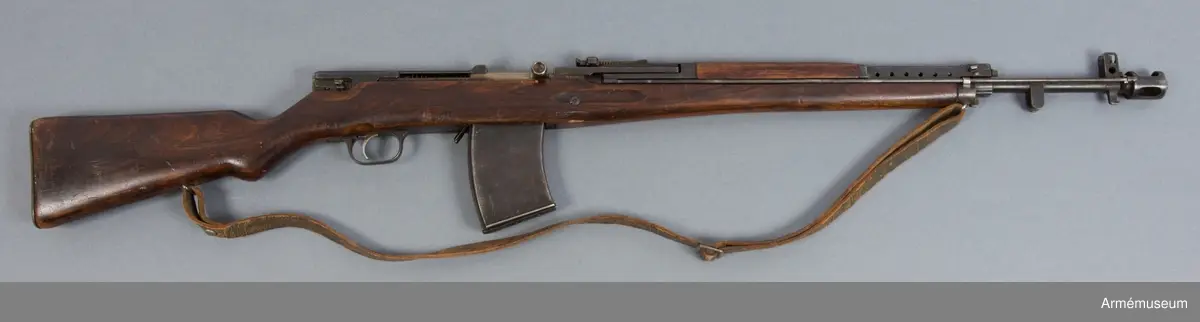
Automatic Rifle m/1936
Simonov, Sergej
The ACP-36 rifle model was used by the Soviet Union and Finland during the Second World War. It was thus replaced by the old Mosin m/1891-rifle within the Soviet army. Automatic rifles m/1936 were produced in a relatively small amount compared to the successors and were expensive to produce while giving rise to field problems. A common phenomenon was that dirt was looking into the mechanism. Sources indicate a variable number made between 35.000-65.000 depending on the source you trust. The first prototype was completed in 1931. The first time it was seen in public light was at the military parade in Moscow in May 1938. Production started at a leisurely pace in 1934 with maximum intensity in 1937-38 to end in 1940. Only a smaller quantity was produced after 1938. A dispyt within the Politburo broke out about which of Simonov or Tokarev’s construction was considered best. The police agency decided to use SVT-38 and it was put into mass production. Stalin also had personal contacts with Tokarev so Stalin took a lot for his construction. The ACP-36 was used on a wider front in the Winter War in Finland, although it was first introduced in the Soviet-Japanese border conflict in the Battle of Khalkhin Gol in 1939. Most were collected to be destroyed in 1943-44. Furthermore, the other specimens were taken care of by the Finnish army, which was hardly impressed by the performance of the weapon, but became popular with some Finnish soldiers after all. The example is a gift from Johan Marcks von Würtemberg, whose father Stig Facht took part in the Swedish Volunteer Corps in Finland during the Second World War. The weapon has until the submission to the Armémuseum was kept in the home. Stig Facht underwent his military basic training at the cavalry at K3 in Skövde. In 1938 he was editor of the English-Swedish Military Dictionary. In 1939 he took a position as a lieutenant in the Swedish Volunteer Corps and was in Finland in 1939-1940. In connection with these efforts, the weapon in question was taken from a former Russian soldier in Finland. Facht then served as 1. Adjutant at II. The battle group and wrote the following about the strapwood in northeastern Finland from Vaaranlahti towards Käsmänperä over the frozen Kemijärvi on 25 February 1940. The source is taken from the book “Swedish Volunteers in Finland 1939-1940” (Military History Publishing House 1989), page 98: Tracking in the loose and meter-deep snow was extremely demanding, and the march moved forward at a rather slow pace. To try to follow the difficult Finnish map in the current dark even in daylight was unprofitable and only to follow the plow track. Some slopes were really sucking, and it was not without thinking about the heavily laden trossvehicles in the main force with a foul concern. At 10 o’clock in the evening the weather suddenly struck about. The clouds disappeared and a large, clearly luminous moon turned the landscape into a full fairytale forest. At the same time, the gender became noticeable. The fur and face covers come on, and the breath stood like a white steam out of the mouth. Up on the heights and inside the woods, it went well, but out on the lakes and marshes it was to such a pass, that only a narrow run was left open to the eyes. He also downplayed his story (p. 99) about the movements during the night and the long march that took longer than estimated: That walk backwards, I should never forget, because it gave clear and horrible evidence of the strapatser troupe had to endure. The hard shield and the heavy slopes had taken the gadden out of the horses, and the dressings had been stepped and forced to break up at short intervals. Both commanders and manhood lacked practical experience of behaviour during such difficult winter conditions, and as fatigue began to take out their right, the ability to counteract freezes The boys gingo was reduced more or less as sleepwalkers, the otherwise so joyful laughter had solidified on their lips, and on every fourth or fifth man white spots appeared on their face. The command had worked heroically during the night and was almost completed. There came a volunteer, who with icy skivante rubbed his nose so that all the leather had disappeared. There another with both rods under his arms and with senseless hands stiff forward. There a third, who ideally reiterated: 'I have no sensitivity in my feet. I have no sensitivity in my feet. It was gruesome. Stig was otherwise unhappy to tell himself about the incidents in Finland because of the difficult conditions that prevailed there, in a piecemeal 45 degree cold, movements only on foot or skis, without a vehicle. After the war operations in Finland, Facht was a war camp at I 18 on Gotland. He participated after the war in Folke Bernadotte’s delegation for the United Nations mediation mission in Palestine in 1948 and authored a report on the events that were also published. He was then listed in the reserve but continued to work civilly, for example as head of the Austrian State Tourist Office in Stockholm.
Sign in to order prints, canvas, and more of this work. Browsing and full-resolution downloads stay free.