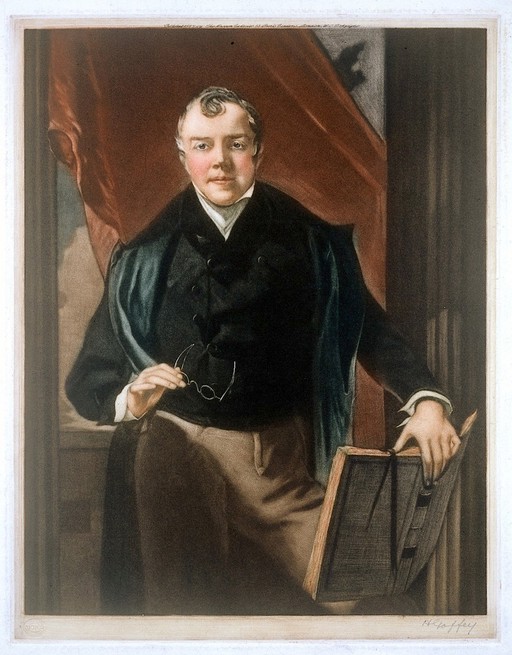
Charles Bell. Colour mezzotint by H. Goffey after J.
John Stevens
Portrait of Sir Charles Bell by Goffey after the painting by John Stevens in the National Portrait Gallery Charles Bell was a Scottish surgeon, anatomist, philosopher and illustrator, and a man of great scholarship and talent. He studied medicine at Edinburgh University and by assisting his brother John with surgical teaching and providing anatomical illustrations. In 1804 he moved to London where he had a varied and controversial but not successful career. In anatomy he published works on the anatomy of expression and on the functions of different parts of the brain: his ideas about the differing functions of the cerebrum and the cerebellum had already been proposed by the French physiologist Magendie, a fact which Bell tried to obscure. He acquired the anatomy school in Great Windmill Street that had been founded by William Hunter, and he taught anatomy there to medical and art students. In surgery he published works on gunshot wounds and attended the wounded in Brussels after the Battle of Waterloo. His most ambitious drawings portray the sufferings of the wounded soldiers. In academia he was the first professor of anatomy at University College, the founding college of the University of London. His best-known philosophical work is his treatise on the hand, that uses the anatomy of the hand as evidence for the existence and goodness of God. He opposed the careless and cruel practices of some physiologists of his time (such as Magendie) in animal vivisection (the dissection of living animals).
Sign in to order prints, canvas, and more of this work. Browsing and full-resolution downloads stay free.


