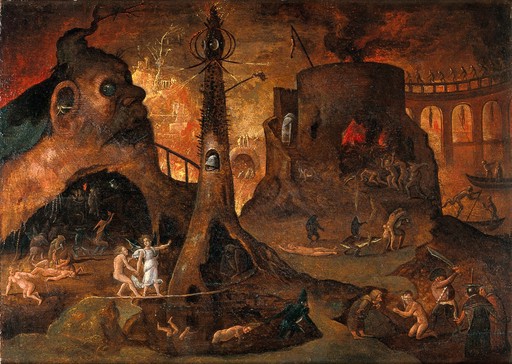
An angel leading a soul into hell. Oil painting by a follower of Hieronymus Bosch.
http://data.europeana.eu/agent/60430
In this painting, a naked man arrives in hell escorted by a winged angel clad in white. The naked man is presumed to be a soul of the dead. Monsters inflict horrendous tortures on the damned who are already there. The angel who accompanies the soul of the deceased to the underworld is called the 'psychopomp'. In ancient Graeco-Roman religion the psychopomp is Hermes (Mercury), but Christian doctrines are more vague on how the soul actually reaches its post-mortem destination: in some versions the event itself happens immediately after the death of an individual, while in others it happens after Judgment Day. Paintings, poems and songs have contributed as much to the idea of hell as official doctrines. Hell is depicted in mediaeval and early modern churches and cemeteries (as at Pisa) as well as on Buddhist paintings of the realm of Yama. The torments of the damned reflect the tortures inflicted by torturers acting for political masters and judicial authorities in the secular dungeons of this world. One master painter who specialized in the genre of hell-scenes was Hieronymus Bosch (died 1516). His enormously popular pictures were emulated by many artists throughout the 16th century, in Italy as well as in the Low Countries. The present painting was at one time in Rome and may have been painted by an Italian painter. The rotunda in the right middle-ground is similar to Virgil's tomb at Piedigrotta, near Naples - appropriately, as Virgil described Aeneas' descent to the underworld in the "Aeneid", and acted as Dante's guide to the underworld in Dante's "Inferno".
Sign in to order prints, canvas, and more of this work. Browsing and full-resolution downloads stay free.


