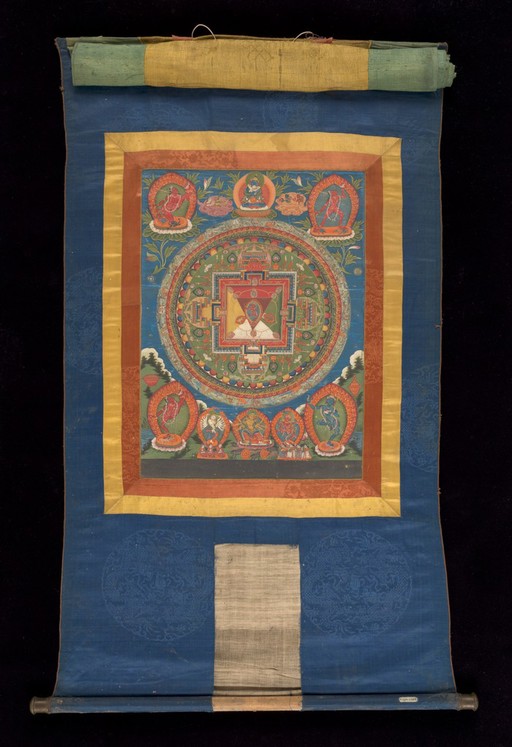
Mandala of Vajrayogini. Scroll Painting (thangka), Tibet.
Unknown artist
Mandala of Vajrayogini. Scroll Painting (thangka), Tibet, 19th century. In the centre of the painted area is a circle (mandala), with other shapes inside it and various figures outside. In the centre of the mandala is a small brown triangle in which Srivajra (Tibetan dPal-rdo rje) ?akini is standing in the dancing attitude. Srivajra is a form of Vajrayogini (Tibetan rDo-rje rNal-byor-ma). Around the brown triangle are four triangles of other colours (red, green, white and yellow). Within these triangles are twelve small female figures, some with animal heads. The triangles are surrounded by a wall with four gates, each leading to a palace flanked by two kalpatarus (wishing trees). In the eight wishing trees are the Eight Auspicious Things: a good elephant, horse, queen, minister, conch shell, mirror, lotus flower and unending knot. Between the palaces are umbrellas, pairs of camaras (fly whisks), and medallions with even smaller figures. Round the palaces there is a lotus border. Eight cemeteries surround the whole mandala. Outside the mandala, in the centre of the top row, is the blue Vajradhara (Tibetan rDo-rje-'chan or Phyag-na rdo-rje) wearing Bodhisattva ornaments, a green shawl and a red dho?i (loin cloth). He holds vajra and bell in front of him which symbolise the two complementary paths to Enlightenment, compassion in acting and wisdom in contemplation, which are complementary to each other like male and female. He is embracing a white consort, probably Prajñaparamita, the Perfection of Wisdom. In the top row, the left and right figures are other forms of Vajrayogini. They are also Dakinis, that is, female beings which can manifest as goddesses, or in human form, or with animal heads and human bodies. The one on the left-hand side is kneeling with her right leg on a dark human being wearing a panther skin. She has thrown her left leg over her left arm. Her wrathful aspect is represented by the skull bowl containing blood which she holds in her left hand. Under her left arm is the khatvanga, the magic staff, showing that she is an operative power in rituals. Her right hand forms the fascination gesture, showing that she is able to dominate evil spirits and to counteract evil conditions. The Vajrayogini on the right-hand side is stepping to the left, her left leg being bent and her right leg straight. She holds a skull bowl in her raised left hand and a vajra (thunderbolt, symbol of indestructible reality) in her right hand which forms the fascination gesture. She carries a khatvanga in the form of a staff topped by three heads and vajra and adorned with five-coloured ribbons on her left shoulder. In the clouds between the Dakinis, four deities are offering homage. Along the bottom are five figures. The left one is a third Vajrayogini, treading with a bent right leg on a pink human being, while throwing her left leg over her left arm. She holds a skull bowl in her left hand and a vajra in her right hand which forms the fascination gesture. Second from left is the sixteen-armed white Marici in the dancing attitude with her right leg bent and held by one of her hands while her left leg is standing straight. She is wearing Bodhisattva ornaments and a blue and red dhoti. All her hands are forming the fascination gesture, and each holds a golden object. In the centre of the bottom row is a yellow eight-handed Vajravarahi (Tibetan rDo-rje Phag-mo) with a brown boar's head at the side of her own head. Next to her is the red, four-armed Marici with a flame aureole round her head. She is wearing a garland of heads rather than the usual skulls. She is also wearing bone ornaments and a tiger skin. She is shooting an arrow from a bow with her two upper hands and forming the fascination gesture with her lower right hand in which she holds an elephant goad. Her legs are in the dancing attitude, with her left leg bent completely, with thigh and shin being parallel and the right leg straight. She is standing on a chariot drawn by pigs, and worshipped by four people wearing white trousers with black stripes and long orange-coloured shawls. Below the sixteen-armed white Marici, three monks are sitting on a rug. On the right is a blue Vajrayogini.
Sign in to order prints, canvas, and more of this work. Browsing and full-resolution downloads stay free.


