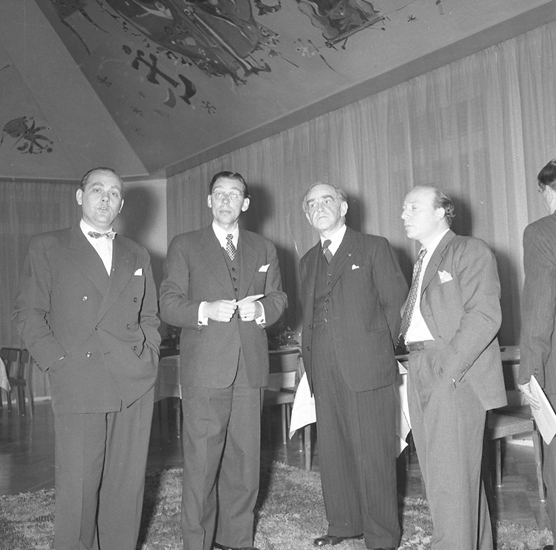
"Lysekil. Invigningen av Hotell Lysekil. 1952.05.28"
Clevfors, Alvar
The Festhouse with the ceiling painting “Masquerade on Gullmarens Bottom” created and executed by the artist Endre Nemes (1909-1985) in the technique stucco lustro. To his deer was the stucco maker and more Domenico Inganni. To the right in picture is the artist who has executed the 170 square meter ceiling painting under which the men gathered. Architects for Hotell Lysekil were Nils Sterner (1904-1990) and Sture Frölén (1907-1999), both mainly active in the Stockholm area. Literature: Nemes, Endre “Raising time and waving it aside,” Carlsson’s Book Publishers 2002. Memoirs that emerged almost 20 years after the scribe’s demise. His wife Britt-Louise Sundell Nemes and daughter Lena Nemes made sure that a release was made. Pages 271 - 277 are about how the roof painting in Hotell Lysekil’s party hall came about for some intense months in the winter of 1951 and spring of 1952. Extract from the text: In 1951 I was commissioned by the Vara company to make a ceiling painting in Hotell Lysekil. I received a letter from architect Nils Sterner, who was then chief architect at Stockholm’s Real Estate Agency and he thought the roof of the festive floor would be embellished with a large painting. It was a square room of 10 x 10 meters, with a maximum height of 11 meters. The roof was pyramidal. I had never made a stucco lustro, but thought it would fit here. I made sketches and saw to me that it would be a single-colored bottom color, a clean, bright cobalt blue and on the bright cobalt fields decorative figurations would dance. Perhaps reminded one and another detail of Miró’s work, but with quite different objectives. I thought more about early Swedish and Danish church paintings with grotesque elements and on the sea with their vicious life outside. The mission was huge. The sketches were preferred for architects Nils Sterner and Sture Frölén in scale 1: 20 and my proposal was accepted by both of them and the Vara company. I would immediately set in the middle of winter and in the spring, sometime in April the work would be finished. It was a terrible difficult and big job. I made the cartons in smaller pieces in my studio in school and then have to stick and patch the pieces together to get up on a natural scale. So one day I went up to Lysekil, with several of my students to help, to try to try the cartons in the room itself, to see the distance and so on, but it was difficult to adapt the cartons on the sloping roof. I persuaded our student Domenico Inngani to help me with the stucco work, but it turned out that it would not be enough for him alone, but also a friend of him, Nino Defendi, was persuaded. An agreement was made with the Vara company about the honorary, I want to remember that it was. Millroth, Thomas. Endre Nemes. Liber Publisher Stockholm 1985. Extract from the book about the party floor at Hotell Lysekil: At Valand, Endre Nemes wanted students to learn or at least get acquainted with as many materials as possible, not least with those that could be used in public works. He himself was open to use all kinds of materials. Between 1951 and 1952 he worked with 170 square meters of stucco lustre in a roof in the party floor of Hotell Lysekil. He looked after the colouring of the whole room. Stucco lustron has a blue bottom. The roof is vaulted in four fields. Over the bright blue, a myriad of fantasy figures, capable of bringing thoughts both to the riches of the sea, to star-pictures, to events and people. On the floor, large ryamatas were planned, composed in red, pink and gray. As a full-bodied, down-to-earth counterpoint to the floating roof. In the ceiling painting a pantomime or bizarr dance is underway. The figurations that thread the dance are held in saturated powerful colours such as orange, deep red, ocher and brown. The work was brought to the attention of the press. Gunnar Hellman wrote in Afton Tidningen, that the hotel’s biggest sights are Endre Nemes' roof painting in the party floor, which is located in the second stage with a view of the sea. One gets an immediate sense of air and sea here as well as entered into an intimate association with the grandiose room. The roof has a pyramid shape and on the four triangular fields Nemes has created one of its most interesting and interesting works. (16.9.1952) It looks beautiful. In photography. For the stucco lustron, an uncanny fate went to meet. In 1961, the management of Hotell Lysekil decided to redesign the room. It was not enough that the fittings and furniture that went into tune with the original intentions were put there. The painting itself was covered with a burlap and, with the complete translucency of the disclaimer, was claimed for acoustic reasons. The basis lies understands in the lack of respect for visual art, which often prevails. A fate that too many of our country’s public works of art met. [In the last decades of the 19th century, the roof painting was again visible. A picture screen: Article in Bohusläningen probably 28 May 2003 “The ceiling painting made the guests acid,” Terje W Fredh.
Sign in to order prints, canvas, and more of this work. Browsing and full-resolution downloads stay free.