EARLY MEDIEVAL BROOCH
420
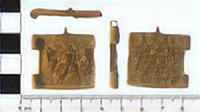
An incomplete early Anglo-Saxon cast copper-alloy small-long brooch (c. 450-c. 550). This was originally thought to be silver and so given the Treasure case number 2014 T234.Description: The head-plate is rectangular and slightly curved when viewed from above. It measures 17.0mm in width and 11.6mm in height and has a thickness at the centre of 1.7mm. On the lower edge of the head-plate, either side of the top of the bow, there is a small cut-out or semi-circular notch. The bow, small but prominent, has chamfered corners making it flat in cross-section at top and bottom. In the centre it is triangular in cross-section, flat at the rear, and measures 10.2mm in height, 5.9mm in width and 4.6mm in thickness.Immediately beneath the bow, the leg has a D-shaped lappet to either side giving an overall width of 12.8mm. Below the lappets, the foot is flat at the front and rear and has bevelled edges. It tapers in width towards the terminal. At the top the width is 6.3mm and at the terminal the width is 4.1mm. The terminal has a V-shaped notch, pointing upwards, at the centre, giving it an inverted U shape. This notch is flanked by two minor notches or nicks to either side. The edges of the terminal are bevelled.On the rear face the pierced pin-lug is situated on the lower part of the head-plate and is partially obscured by corroded iron. It is D-shaped in side view and measures 5.3mm in height, 1.8mm in thickness and protrudes about 6.0mm. The catch-plate has a maximum height of 8.9mm and a thickness of 1.2mm. Its curled-over part to secure the pin is intact; it curls to the left when the reverse is facing the viewer.This brooch has an even brown patina and there is no indication of burning or melting. At the front, minor striations on the head-plate and foot can be seen under magnification. The pin is missing.Dimensions: 44.1mm (height); 17.0mm (width); 12.1mm (overall thickness). Weight: 5.86g.Analysis: Non-destructive X-ray fluorescence analysis of the surface identified the metal as bronze, an alloy of copper and tin, with significantly less than 10% precious metal.Discussion: This small-long brooch is smaller than most. There are some comparably tiny brooches from the cemetery at Great Chesterford (graves 45, 69 and 114) and one from Wasperton (grave 145) but small-long brooches are more often at least half as big again.The shape of the head-plate and bow are common and can be easily paralleled. The shape of the foot, however, is more unusual. It is not readily paralleled among small-long brooches and finds its closest similarities among miniature bow brooches with triangular or semi-circular headplates such as NMS-1BE176, KENT-F9D7C2, IOW-8F68C4 and IOW-E94E22. These unusual brooches may be drawing some inspiration from brooches of Continental manufacture.Date: Great Chesterford graves 45 and 114 are dated by their beads (Brugmann's Phase A1) to the 5th century, but it is equally possible that diminutive small-long brooches continued in use into the early 6th century. The miniature bow brooches with triangular or semi-circular head-plates and triangular footplates ending in rounded terminals appear to be late 5th-century on the Continent, but also could in England last into the early 6th century.
Sign in to order prints, canvas, and more of this work. Browsing and full-resolution downloads stay free.