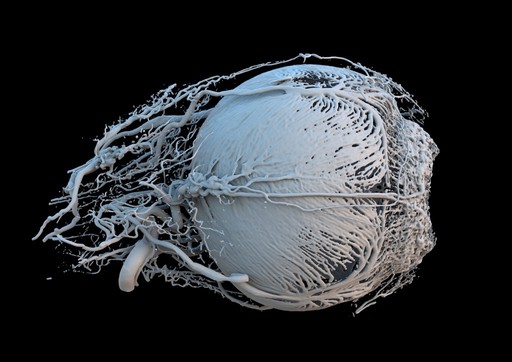
3D print of vessels of a healthy minipig eye
Dr Peter M Maloca
3D view on vessels of a healthy minipig eye. The opening on the right corresponds to the pupil as the gateway input of all light into the eye. It is interesting to see the marked abundance of vessels of the pupil which bring energy and food to the muscles to control the amount of incident light. The other large vessels are feeder vessels for the outer layers of the retina and muscles, so, that the eye quickly can perceive the environment and the creature may adapt and survive. Information about the blood vessels was taken by injection of a newly developed, high-viscous contrast media. Micro-CT scanning was applied and a 3D vessel volume rendered. Images were freed from speckle-noise with a three-dimensional filter to enhance the signal. Obtained vessels were extracted to produce a template for a 3D printing. The axial length is 19 millimeter. The smallest vessels that have been detected are 20-30 microns in diameter. Print method: 3D Print FDM Print material: ABS ABS Acrylonitrile-butadiene-styrene (ABS), is an amorphous thermoplast. Characterized by high strength values, high resistance, hardness and good scratch resistance. ABS is composed of three different monomers: acrylonitrile, (1,3-) butadiene and styrene. Every body knows ABS, as a typical product made from it is the Lego® building blocks, Print time: 39h Wellcome Image Awards 2017.
Sign in to order prints, canvas, and more of this work. Browsing and full-resolution downloads stay free.


